
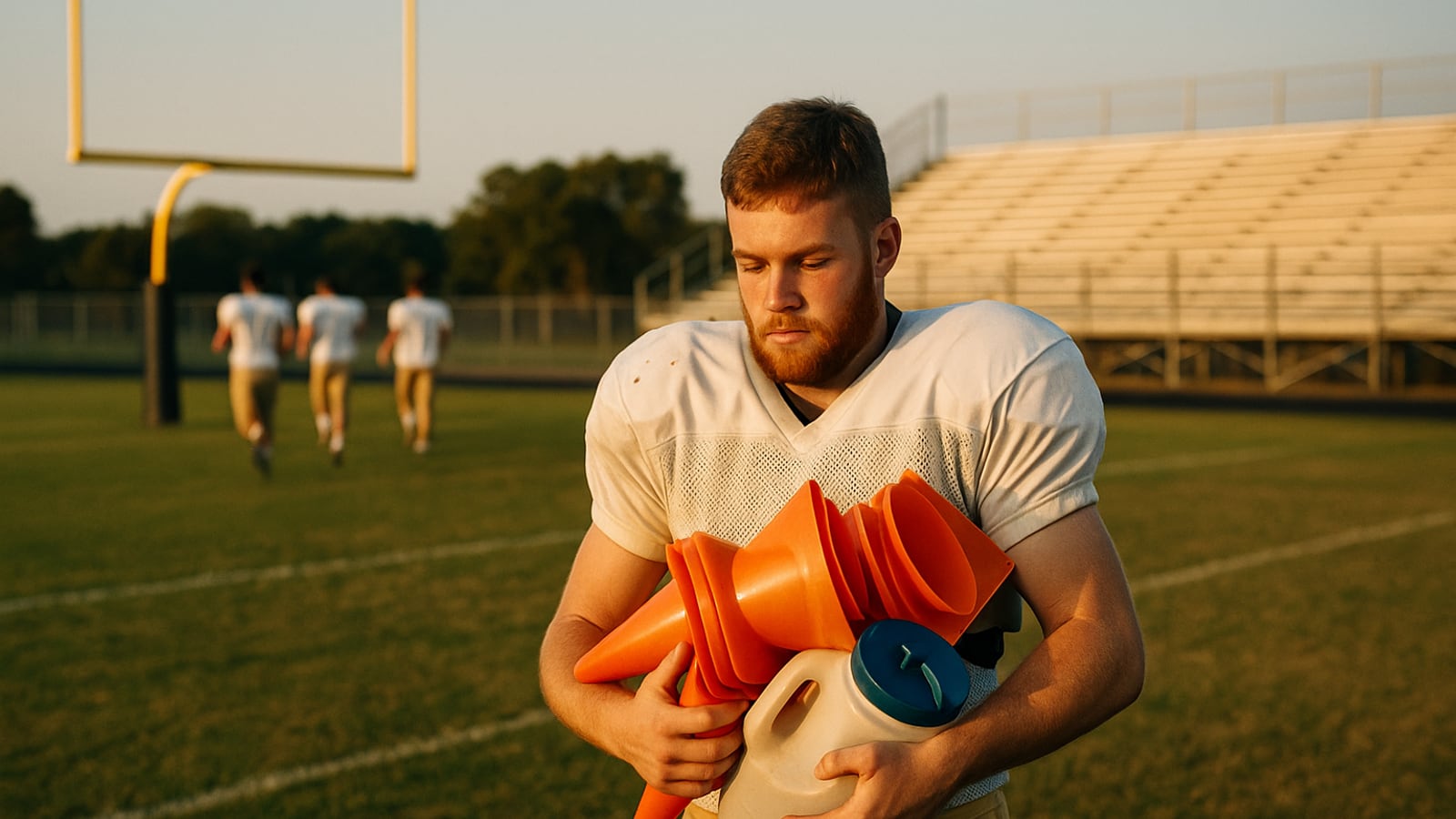
Practice ends at 5:30. Coach blows the whistle, twenty guys head for the gate, and out on the field there are still eleven cones down, two water jugs sweating in the grass, and a ball bag nobody zipped. Whoever turns around and handles that's the guy this team will follow in two years.
Not because cones are noble. Because it's evidence.
Everybody on your roster says they'd do anything for the team. Nobody believes any of it until they watch you do something small that gets you nothing. That's the whole trick. Being a good teammate isn't a personality you're born with. It's a pile of receipts you build up over a season, one boring decision at a time.
Be early in a way that's almost annoying
If warmups start at 6:15, be laced up and moving at 6:05. Not pulling into the lot at 6:14 wearing one sock and holding a breakfast sandwich.
This sounds like a nag until you notice what it does to a room. The guy who's always there first sets the floor for everyone else. Guys drift toward whatever the earliest, most locked-in teammate is doing, because it's easier to match someone than to justify being worse than him.
It also buys you credibility you'll need later. When you eventually have to tell a friend he's dogging it, the only reason that lands is that he's never once seen you dog it. You can't lead on a debt you haven't paid.
Bring your own water. Know where your gear is. Charge your stuff the night before. Sounds like your mom wrote it. Your mom is right about this one.
Praise out loud, correct quietly
Your outside linebacker misses a read and the other team scores. You've got about four seconds and two options.
Option one is yelling at him from twelve yards away so everybody sees you being the guy who cares. Feels great. Accomplishes nothing. Nobody in the history of sports has gotten better at coverage because a teammate broadcast his failure at volume.
Option two is finding him on the sideline, saying one sentence about the next play, and moving on. "They're going to run it again. I've got the flat, you stay home." Short, useful, private.
Flip the volume for good stuff. When somebody makes a play, be loud about it. When the worst player on the team does one thing right in practice, be the guy who says his name. You'd be amazed how much a sophomore will run through for the junior who noticed him once.
The bench is a position, not a punishment
Sitting is going to happen to you. It'll happen the week you were sure you'd earned the start, which somehow makes it worse.
You're allowed to be upset. Be upset in the car. On the sideline, there's actual work: track the other team's substitutions, watch what their best player does before he cuts, and tell your guy what you see when he comes off. Stand up. Keep the water moving. Know the score and the clock so nobody has to ask.
Here's the trade-off nobody mentions. Playing the bench well doesn't always get you minutes. Sometimes the depth chart is just the depth chart, and the coach isn't a genius, and you deserved better. Do it anyway. You will carry how you handled that year into every locker room, job site, and marriage you ever walk into, and you'd rather not carry sulking.
Captain isn't a trophy for being the best player
Some teams vote. Some coaches pick. Either way, the armband isn't a reward for your stat line, and if you treat it like one you'll be the loneliest guy on the roster by October.
The job is mostly translation and maintenance. When the coach says something harsh, you're the one who tells the freshman what he actually meant. When the freshman is scared to ask why he keeps getting pulled, you ask for him. When two guys are sniping at each other over nothing at Tuesday practice, you get them to knock it off Tuesday, not Friday.
And you take the first rep of the ugly drill. Every time. Conditioning, tackling dummies, the up-downs everyone hates. The captain goes first, finishes the set, and doesn't complain in front of anyone younger than him.
The conversation you'll want to skip
At some point your actual friend is going to start showing up late, coasting through lifts, and blaming everybody but himself. You'll want to leave it to the coach. Don't.
Do it one-on-one, the same day, and keep it under a minute. Lead with a question instead of a verdict: "You've been off for two weeks. What's going on?"
Ask first because you might be wrong about the reason. Maybe he's working nights now. Maybe things are bad at home and practice is the only hour he doesn't have to think about it. Maybe he's hurt and hiding it. You don't get to skip to the lecture until you know.
If it turns out he's just being lazy, say the plain version: "I need you Thursday. You're better than what you gave today." Then stop talking. No speech. Guys respect the short version and resent the long one.
When it's bigger than you, hand it up
Some things aren't a captain's problem to solve alone, and pretending otherwise is how people get hurt.
If older guys are running "initiation" on younger ones, that's hazing, and it's NOT a tradition. If a teammate is hiding a head injury and begging you not to say anything, he doesn't get a vote. If somebody is pressuring a younger kid into anything he doesn't want to do, or if a teammate says something that makes you think he might hurt himself, you're out of your depth and that's fine.
Go to the head coach, the athletic trainer, the athletic director, the school nurse, or your parents. Today, not next week. Name what you saw, plainly. You won't be in trouble for reporting it, and telling an adult isn't snitching on your team. It's the most captain thing you'll ever do.
Losing is the audition
Anyone can be a great teammate up eighteen points. The film that matters is the bus ride home after you blew a game you should have won.
No blaming. No slamming helmets into the equipment cart. Find the guy whose mistake ended it and go sit next to him. You don't have to say anything profound. "Long night. You're still my guy." Then talk about something else entirely.
That's the moment guys remember for ten years. Not the buzzer-beater. The seat on the bus.
Reputation compounds faster than skill
Coaches talk to other coaches. Your coach is going to write somebody a recommendation for a job, a camp, a scholarship. He writes it about the guy he watched when nothing was on the line.
And your little brother is watching how you talk to the worst player on the roster. He's learning what a man does with a little bit of authority. He'll copy it exactly, including the parts you'd rather he didn't.
So. The cones are still out there.
Go turn around.
Ade Fisher
Young Men
Teaches the trades intake at a community college. Writes the manual he wishes his students arrived with.

Read next