
Drive like the calmest person in the car
Mirrors, empty parking lots, the left turn everybody fears, and the one phone call you make instead of getting in the car.
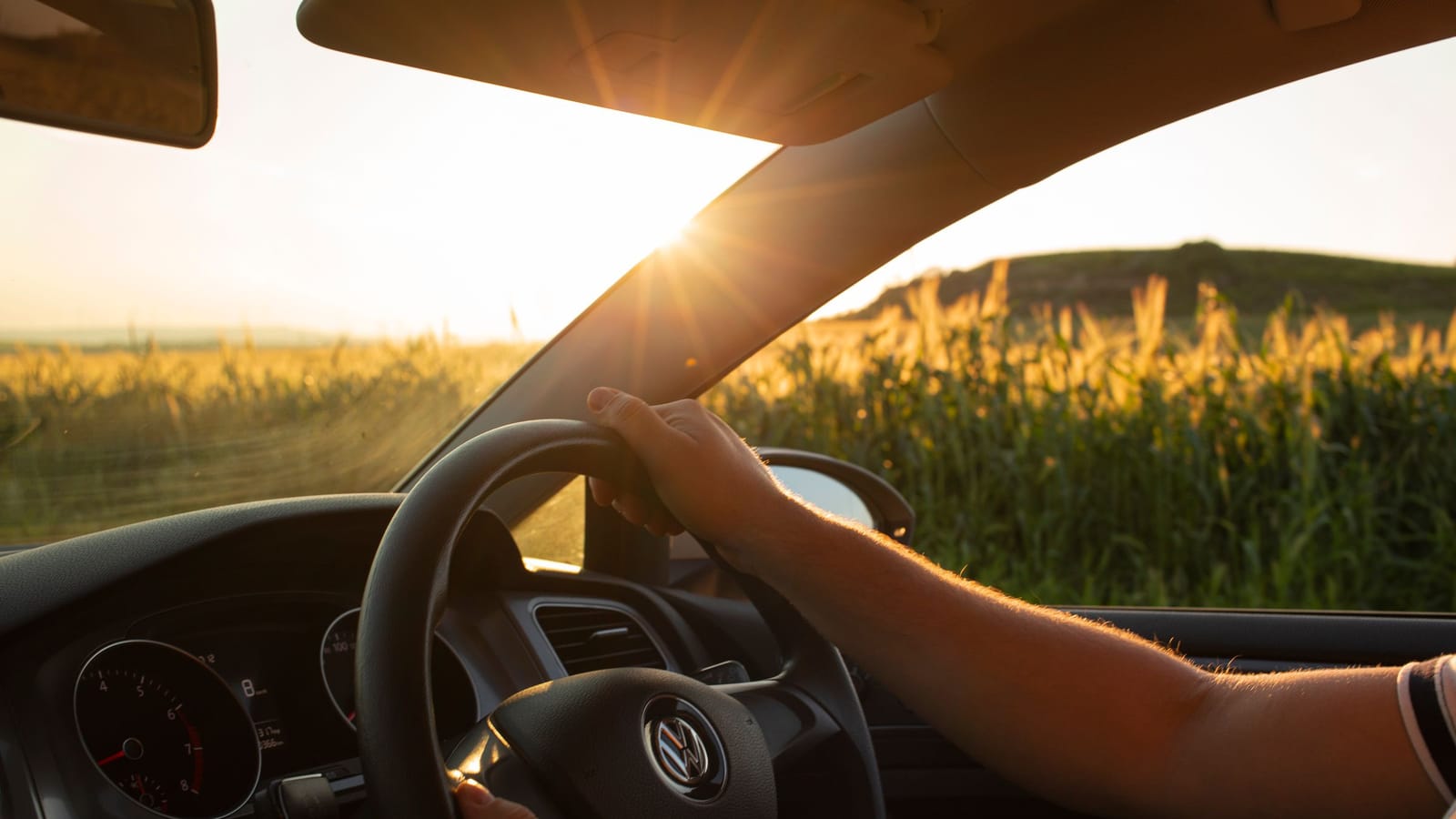
Before you turn the key, fix your mirrors. Not the way the last person in the seat had them. Sit up, adjust the seat so your wrists can rest on top of the wheel with your shoulders against the seat back, then set your side mirrors out wider than feels right. If you can see the side of your own car in them, they're aimed too far in. Push them out until your car just disappears. Your blind spots shrink. It takes eleven seconds and almost nobody does it.
Hands at 9 and 3, not 10 and 2. Airbags come out of the middle of the wheel fast and hard, and you don't want your arms crossed over the center when that happens. Thumbs along the rim, not hooked inside the spokes.
That's the whole first lesson, and you haven't moved yet.
The parking lot is the point
Every good driver you know got that way by being bored somewhere safe first. Find a big empty lot on a Sunday morning, early, before the stores open. Church lots, high school lots, the far corner of a mall lot. Bring a parent or whoever is legally allowed to supervise you in your state, and bring an hour.
Then do unglamorous things. Drive in a straight line at 10 mph and stop smoothly at a painted line, twenty times, until the car stops without anybody's head bobbing. Reverse in a straight line the same number of times, with your right hand on the passenger headrest and your body turned so you're actually looking through the back window. Not the camera. The camera is a bonus, not a method.
Then learn where your car ends. Put an empty cardboard box down and pull up until you think your bumper is a foot away. Get out and look. You'll be wrong by about three feet the first ten times. That gap between what you think and what's true is the entire reason parking feels impossible, and it closes fast once you check.
Pick your teacher on purpose
Some parents are excellent in the passenger seat. Some grab the dashboard and inhale sharply every time a mailbox goes by, which teaches you nothing except that you're doing something wrong, constantly, in a way nobody will name.
If that's your situation, say it out loud, kindly, when you're not in the car. Try this: "When you gasp, I can't tell what I did, and I start watching you instead of the road. Can you just say the word? 'Brake.' 'Mirror.' 'Too fast.'" Most adults will take that well, because most of them are scared for you rather than annoyed at you. If it still doesn't work, ask a different licensed adult in your family to take the highway sessions. Splitting it up isn't a betrayal. It's project management.
Professional lessons are worth it if your family can swing them, mostly because an instructor has a second brake pedal and no emotional history with you.
The three things that actually scare people
Merging onto a highway. The mistake is entering the ramp slowly and hoping. The on-ramp exists to let you get up to the speed of traffic before you arrive. Look over your left shoulder while you accelerate, find the gap, commit to it. Slowing down at the end of a ramp is how people get hit.
The unprotected left turn. The one where you're waiting in the intersection with no green arrow and cars keep coming. Wheels straight while you wait, always, so that if someone taps you from behind you don't get pushed into oncoming traffic. Then wait for a real gap, not a hopeful one. If the light turns yellow and nothing opened up, you finish your turn on the yellow, clearing the intersection. That's legal in most places and safer than sitting there.
Parallel parking. It's a memorized sequence, not a talent. Pull up even with the car in front, about two to three feet out. Reverse until your back bumper lines up with their rear bumper. Full turn toward the curb, reverse until your car is at roughly 45 degrees. Straighten the wheel, back up a little more. Then full turn the other way and swing in. Practice it with two trash cans in your driveway until the sequence is muscle memory. It's a party trick you'll use for fifty years.
Rain, dark, and the stuff you can't schedule
Get supervised hours in bad conditions before you're alone in them. Rain at night is genuinely harder, because lane lines vanish under the glare and everything reflects. The fix is slower, longer following distances, and headlights on even when it's just gloomy.
Count your following distance. Pick a sign, and when the car in front passes it, say "one thousand one, one thousand two, one thousand three." If you pass it before you finish, you're too close. In rain, make it four or five seconds.
Also learn where the defroster button is, how to switch on the rear defrost, and how to work the wipers without looking down. Fumbling for a control at 45 mph is how people drift.
The phone isn't a gray area
It goes in the glove box or on the back seat. Not face-down in the cup holder, where you'll still see it light up.
Set your destination before you shift out of park. If you need to change it, pull over. If you need to answer somebody, they can wait, and if they can't wait they can call your mom. There's no version of this where you're the exception, and there's no message worth the rest of your life or somebody else's.
Passengers, and the rides you don't owe anybody
Most states limit how many passengers a new driver can carry and how late you can drive during the first year. Look up your own state's rules and follow them even when nobody would know. They exist because a car full of your friends is the single loudest, most distracting environment you'll ever try to concentrate in.
And once you have keys, people will want things from you. Rides to practice, rides to the mall, rides at 11 p.m. to somewhere you don't want to go. You get to say no. "I can't tonight" is a complete sentence and you don't have to build a legal case for it. A license is a responsibility you carry, not a service you owe.
If a friend asks you to drive somewhere your parents wouldn't be okay with, that's the moment you stop and think about who's actually being served.
The call
Some night, you're going to be somewhere and the person who drove you isn't okay to drive home. Maybe they've been drinking. Maybe they're just wrecked tired or so upset they're shaking.
You call your mom, your dad, whoever is home. Tonight, in front of everyone, from the driveway if you have to. Say where you're and ask them to come.
Have that conversation with your parents now, before you ever need it, and get them to say the words: call me and you're not in trouble. Most parents will say it immediately, because what they want is you, in the house, alive. If for some reason you can't reach them, call another adult you trust. An aunt, a coach, a youth leader. Somebody's mom.
You will never regret that call. People regret the other one.
What the test actually checks
Examiners aren't looking for flair. They want head movement at every intersection, full stops behind the line, mirror checks before every lane change, hands staying on the wheel, and speed within a few miles of the limit. Exaggerate the head checks. They can't read your eyes, only your neck.
Go the week you're ready, not the week you turn eligible. If you fail, you rebook. Half the confident drivers you know failed something the first time and simply never mentioned it.
The goal was never the plastic card. It's being the person in the driver's seat that everyone else in the car quietly trusts.
Nina Castellan
BRO for Her
Runs the women-facing desk. Same standard, same tools, written for a different reader — not a softer one.

Read next