
Your acne routine should take four minutes
Scrubbing harder is why your face stings. Do a few simple things twice a day, keep your hands off, and give it two months.
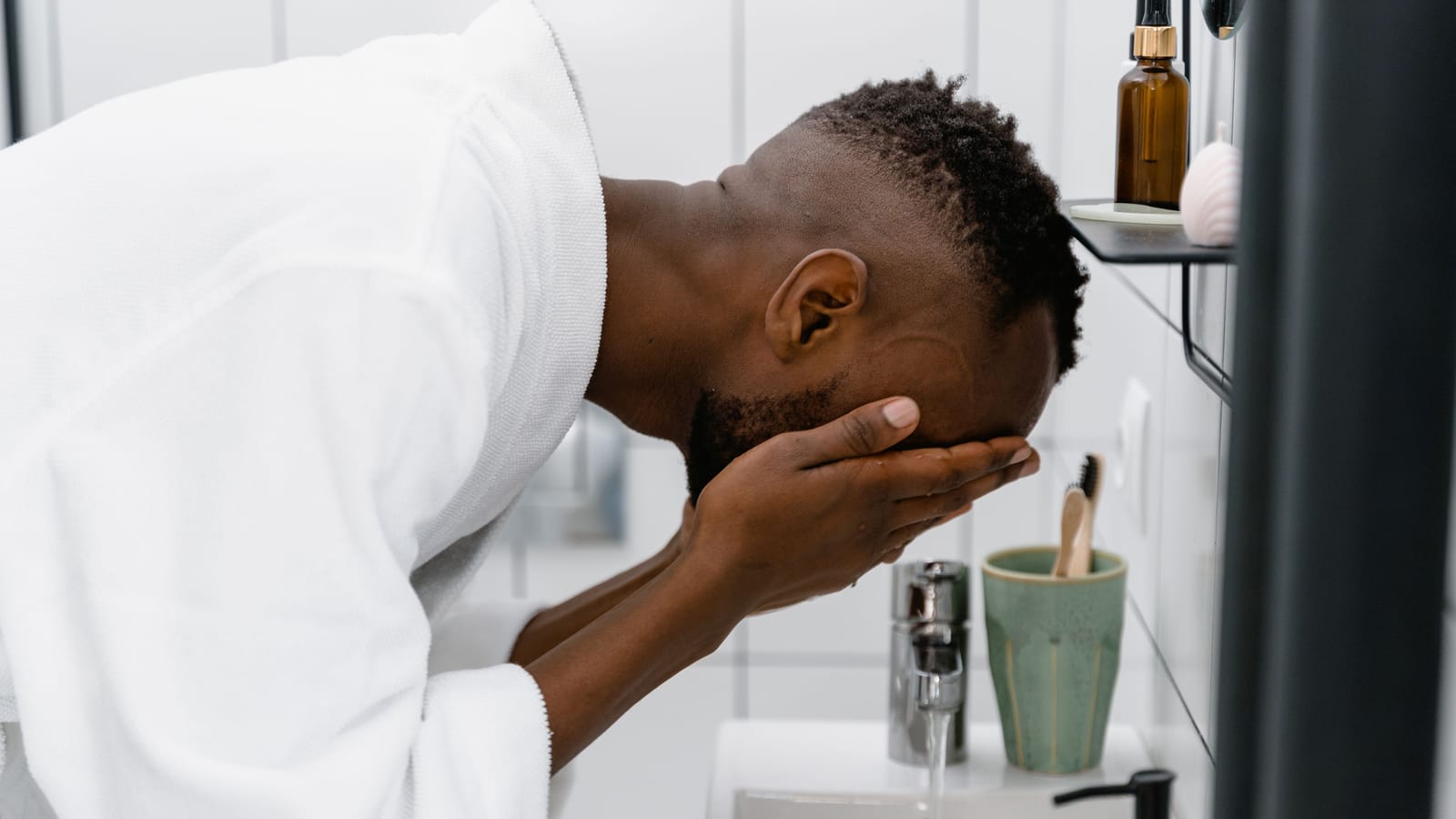
Put the apricot scrub down.
You know the one. Gritty, smells like a candle, feels like it's really doing something because your face is pink and tight afterward. That tight feeling isn't clean. That's your skin's outer layer taking a beating, and when it takes a beating it tends to get red, flaky and oilier than it was before. Then you scrub again to fix the oil. That loop can run for years.
The routine that actually works is boring and fast. Four minutes a day, split between morning and night. The hard part isn't the steps. It's doing them for eight weeks when nothing looks different at week two.
The whole routine, start to finish
Morning. Splash lukewarm water on your face. Not hot. A pea-sized amount of a gentle cleanser, worked around with your fingertips for about 30 seconds. No washcloth, no scrubbing pad, no brush. Rinse, then pat dry with a clean towel instead of dragging it across your face.
Moisturizer next, even if you're oily. Especially if you're oily. Skin that's stripped dry will often pump out more oil to compensate. Look for something labeled oil-free or non-comedogenic, which just means it's formulated not to clog pores.
Then sunscreen, SPF 30 or higher, if you're going to be outside. Sun doesn't clear acne. It tans around the marks and makes the red spots stick around longer once you fade.
Any broad-spectrum SPF 30 you'll actually wear every day beats skipping it. If you're picking one, go mineral, meaning zinc oxide or titanium dioxide. Those sit on top of your skin, they're broad-spectrum, and they tend to be gentler on skin that's already irritated. They're also the only two filters the FDA has proposed as generally recognized as safe and effective, while it's asked makers for more safety data on the rest. The catch is that some leave a white cast. A tinted one fixes that. Try CeraVe Hydrating Mineral Sunscreen SPF 30, Neutrogena Sheer Zinc SPF 50 or EltaMD UV Physical SPF 41 (tinted). Reapply every two hours if you're out, and after sweating or swimming.
Night. Same cleanser, same 30 seconds, same pat dry. If you played a sport, wore a helmet, or had a hat on all day, do this as soon as you get home rather than at midnight. Moisturizer again.
That's it. Two cleansers, one moisturizer, one sunscreen. You can get all four for under forty dollars and they'll last months.
Why gentler beats stronger
Every guy with acne has a phase where he goes nuclear. Astringent that smells like a hospital, a spot treatment on every mark, then a second spot treatment because the first one didn't work overnight. A week later his face is peeling at the corners of his nose and the spots are still there, just angrier.
Your skin has a barrier on the outside that holds water in and keeps irritants out. Alcohol-heavy products and hard scrubbing wreck it. A wrecked barrier stings, flakes, and heals slowly, and slow healing is exactly what leaves marks behind after a breakout clears.
There are over-the-counter treatments with real evidence behind them, benzoyl peroxide and salicylic acid among them. They can work. But use one at a time, start at the lowest strength on the shelf, and ask the pharmacist which one suits what you've actually got. Layering three actives at once is how you end up with chemical burn instead of clear skin.
Hands off. Genuinely off.
This one's free and it's the one nobody does.
Picking a spot pushes the inflammation deeper and turns a three-day bump into a three-week mark. Sometimes into a scar you'll still have at thirty. If you catch yourself doing it in the mirror, walk out of the bathroom. Trim your nails short so it's less satisfying. Some guys put a small bandage over one they can't leave alone, which looks ridiculous for an evening and saves them two weeks.
Same principle for the resting-your-chin-on-your-hand thing in class, and the leaning-your-cheek-on-your-phone thing.
- Pillowcase: flip it midweek, change it weekly. It's two minutes.
- Phone screen: wipe it. It lives in your pocket and then on your face.
- Helmet straps, hat brims, chin guards: sweat plus pressure plus friction is a reliable recipe for breakouts along the jaw and forehead. Wipe the straps down, wash what's washable.
- Hands: wash them before you touch your face, not after.
Sleep matters too, and eight to ten hours is the target at your age, not six plus an energy drink. Drink water. That's the extent of the lifestyle advice, because the rest of what the internet tells you about food and acne is mostly noise, and if you're worried about it that's a conversation for a doctor, not a comment section.
Where GermProof fits
Full disclosure: GermProof is a sister brand of BRO's. I'd tell you either way, but you should know.
It comes as a spray and a gel. It's all-natural and alcohol-free, which is the whole point of mentioning it in a piece about not torching your face. Odorless, non-drying, non-toxic. The ingredient list is short: chelated silver at 200 ppm, distilled water, and vegan chitosan, which comes from mushrooms rather than shellfish, so it's not an allergy problem for most guys.
What it does is form an invisible, breathable barrier on your skin that lasts for hours per application. It soothes irritated skin and supports faster healing, which is the part that matters if your face is already raw from something harsher you tried last month.
It's not an acne cure and it isn't a treatment for acne. Nobody's claiming that. Think of it as one step in the routine above: wash, pat dry, apply to clean skin, moisturize. The gel's easier to aim at one area, the spray's faster over a whole face or across your shoulders and back after practice.
Give it two months before you judge it
Skin turns over slowly. A routine you started on Monday won't show you much by Friday, and switching products every ten days means you never find out whether any of them worked.
Pick your four items. Use them twice a day. Take a photo of your face in the same light on day one so you have something honest to compare against, because your memory of how bad it was is unreliable and the mirror lies to you every morning.
Here's the trade-off, straight up: gentle is slower. If you want your face visibly different in five days, this isn't that. Nothing safe is that.
When to stop experimenting and see a doctor
Some acne doesn't respond to any routine, no matter how disciplined you are. That isn't a hygiene failure and it isn't your fault. It's mostly hormones and genetics, and neither one takes requests.
Go see a doctor or a dermatologist if you've got deep lumps under the skin that hurt, if spots are leaving scars or pitted marks, if it covers your back and chest, or if you've done everything above properly for a couple of months and nothing's moved. Tell a parent you want an appointment. Say the word "scarring" if it applies, because that moves things along.
There are prescription options that work well. Asking for one isn't vanity and it isn't weakness. It's the same instinct that makes you get a bad knee looked at instead of limping through the season.
And in the meantime, know this: every guy in your year is far more worried about his own face than he's about yours. The confidence you're waiting on isn't stored in your skin. Wash your face, leave it alone, and go be useful somewhere.
Ade Fisher
Young Men
Teaches the trades intake at a community college. Writes the manual he wishes his students arrived with.

Read next