
How to fit gaming, school and sleep into the same week
You have more hours than you think. The problem isn't the total — it's the last hour of the night, and that one is fixable.
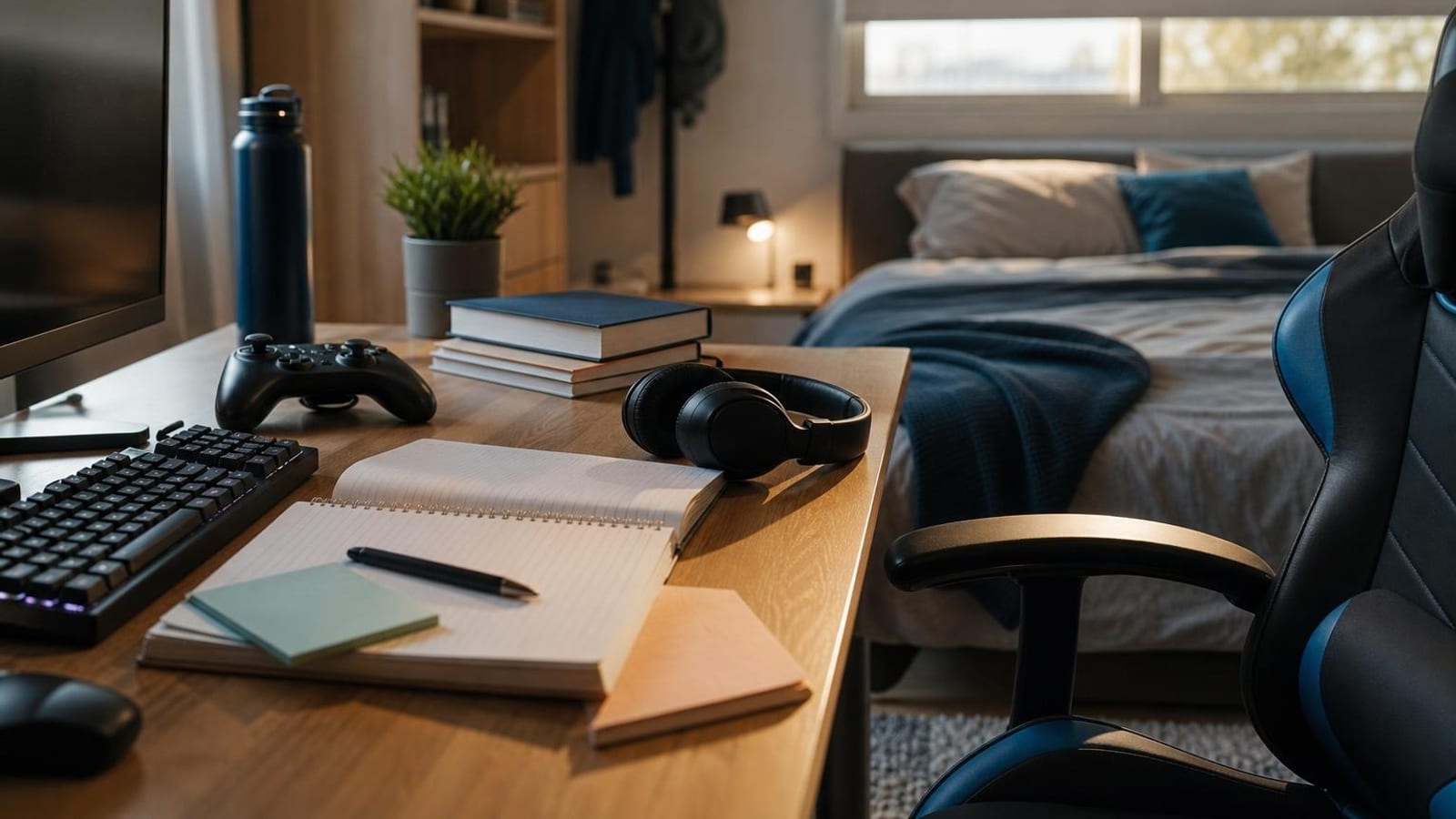
Do the arithmetic once and it changes how the week feels.
There are 168 hours in a week. Say you sleep nine hours a night — that's 63. School, five days, call it 35 with the bell-to-bell reality of it. Add the commute, meals, showers, chores, church or youth group, and you're maybe 20 more. Homework, done properly, another eight or ten.
That's roughly 128 hours accounted for. You've got about 40 left.
Forty hours is enormous. It's more than a full-time job. So when it feels like there's no time for anything, the problem usually isn't the size of your week. It's the shape of it — the hours come in awkward pieces, and one specific hour eats all the others.
The last hour of the night decides the whole week
Almost every bad week for a guy your age starts the same way. It's 10:15. You said you'd stop at 10. You're two games past that, and now you're at the point where you might as well finish the battle pass thing, and then it's 12:40 and your alarm is set for 6:30.
That's not a willpower failure. Games are built so that hour is hard. A ranked ladder never reaches a natural stopping point. Daily challenges reset so there's always something expiring. And a loss makes you want to play again far more than a win does — one more, to end on a good note. That's the hook, and knowing the name of it helps.
You can't out-stubborn a system designed by people much smarter than your 10:15 self. You have to make the decision earlier, when you're not tired and not two points off a rank-up.
Stop rules that actually hold
Pick a count, not just a clock. "I'll stop at 10" is a wish. "Three games, then I'm out" is a decision you can check. Use both — a count, and a hard floor where you stop mid-count if the clock beats you to it.
Announce the last game. If you're playing with friends, say it out loud at the start: "I've got two more, then I'm off." Nobody's annoyed by that. What annoys people is you vanishing mid-match or getting guilted into a fourth. Telling your squad turns your limit into something you'd have to publicly break.
Add friction. Controller in a drawer. Headset on a hook downstairs. Phone charging in the kitchen, not by your bed. None of this stops a determined person, and it's not supposed to. It just adds twelve seconds of thinking to a decision you'd otherwise make on autopilot.
Don't start what you can't finish. A 40-minute mode at 9:50 is a choice to go past 10:30. You already know that when you queue up. Play something short instead, or don't play.
Do the hard thing in the first forty-five minutes home
The order of your afternoon matters more than the total hours in it.
Gaming first and homework after almost never works, because homework has no fixed end and gaming has no natural one. You end up doing the worst version of both — half-attention on the game because you're guilty, half-attention on the essay because you're tired.
Try flipping it. Get home, eat something, and give the first solid block to the single hardest thing on your list. Not the easy worksheet. The thing you've been avoiding. Forty-five focused minutes with the phone in another room will clear more than three distracted hours.
Then game without owing anybody anything. It's a completely different feeling.
Weeknights small, weekends big
You don't need equal gaming every day, and trying to get it's what wrecks Tuesday.
A workable shape for a lot of guys: 45 minutes to an hour on school nights, and a proper long session on Friday or Saturday — the kind where you and your friends actually get somewhere. Trade the weeknight time for weekend time deliberately, instead of stealing it from sleep in fifteen-minute pieces.
Sunday night is the one to protect hardest. Sunday is where you decide whether the next five days are survivable. Go long on Friday instead.
If you've got a test Thursday, move the long session. It'll still be there Saturday. That's not a sacrifice, it's a schedule.
The handoff from screen to sleep
The standard guidance for teenagers is somewhere between eight and ten hours a night, and you're growing, training, and learning on top of it. If you're consistently getting six, that's a real problem and worth mentioning to your doctor or the school nurse — they'll take it seriously and they won't make it weird.
The part people miss is the handoff. You can't go from a ranked match to asleep in four minutes. Your body is still in the game. So build twenty minutes of nothing much between the two: shower, sort your bag for tomorrow, read a few pages, pray if that's part of your night.
Sorting your bag the night before is the highest-value two minutes in the whole system. It buys you a calm morning, and a calm morning is what stops the whole day tipping.
When you're already behind
Sometimes the week gets away from you. You're three nights short on sleep and two assignments behind, and the plan is irrelevant because you're in a hole.
Don't try to fix everything on the same day. Pick sleep first — one full night, early, no gaming at all. You'll do the backlog twice as fast tomorrow as you would tonight at 1 a.m. All-nighters feel productive and produce work you wouldn't hand in if you'd seen it rested.
Then tell somebody. A teacher, a coach, your parents. "I'm behind on two things and I've got a plan" lands very differently than silence followed by a missing grade. Adults are far more helpful when you come to them early, and you're not going to be in trouble for being honest about it.
Bring your parents a plan, not an argument
If gaming is a fight at your house, the fastest way out of it isn't negotiating harder. It's showing up with something specific.
Something like: "School nights, one hour, done by 10, homework first. Longer on Friday and Saturday. Let's check in two weeks and see if my grades and my mornings hold up."
That's a different conversation entirely. You're not asking for permission to play more. You're asking them to judge you on results — and you're giving them a date. Most parents will take that deal, because what they're actually worried about is whether you can run your own life. Prove it for two weeks and you'll get more rope, not less.
And you'll have learned the thing that actually matters here, which has nothing to do with games. Anybody can start. The rare skill, at any age, is being the guy who can stop when he said he would.
The 1 a.m. matches all blur together. You won't remember a single one of them by June.
Ade Fisher
Young Men
Teaches the trades intake at a community college. Writes the manual he wishes his students arrived with.

Read next