
Stand up.
When your wife's friend walks over to the table. When someone comes into your office. When your daughter's coach crosses the parking lot toward you with his hand out. Two seconds on your feet, that's all it is. Nobody can fully explain why it works, but everyone feels it when you do it, and everyone clocks it when you stay planted with a fork in your hand and give a little chin nod.
Courtesy is the cheapest signal a man has and one of the only ones that can't be bought. You can rent a nice watch. You can't rent the instinct to move to the street side of the sidewalk without saying a word about it.
Names, said out loud
Read the name tag before you order. Use it once at the beginning and once at the end. "Thanks, Marcus." That's it. It takes no extra breath and it changes the temperature of the entire interaction, because the guy running the parts counter at 4:50 on a Friday has been "hey man" for nine straight hours.
Same rule for the kid bagging groceries, the nurse who takes your dad's blood pressure, the woman at the DMV counter who has heard every joke about the line. If you can't see a tag, ask. "What's your name?" isn't a weird question.
And when you introduce two people, do the work. Both names, plus one fact each so they've got something to stand on. "Dave, this is Ellen, she teaches at Roosevelt. Ellen, Dave built the deck out back." Then step away. An introduction that leaves two strangers staring at their drinks isn't an introduction, it's an abandonment.
The physical stuff nobody has to explain
Hold the door. Carry the heavy thing. Take the outside of the sidewalk. Put the cart back in the corral even when it's 19 degrees and the corral is forty feet away. Let the merging car in. Hold the elevator with your arm, not your foot.
Don't narrate any of it. The moment you say "let me get that for you, I was raised right," you've turned a courtesy into a commercial.
Some woman will wave you off at the door. It happens. Say "sure," let it go, hold it for the next person. You're not running a campaign. You're just the kind of man who gets there first and puts his hand on the glass.
Time is a courtesy, and most men are sloppy with it
Ten minutes early to anything that involves another person waiting. Not for the airport, for a person. Your barber, your brother-in-law, the guy interviewing you.
RSVP by the date on the card. A maybe is a no wearing a nicer shirt, and the woman planning that wedding has to give the caterer a real number. If you said yes and something breaks, call. Don't text an apology to a group thread at 6:40 for a 7:00 dinner.
And when you're the one running late, the message is the ETA, not the explanation. "Twenty minutes out, traffic on 35, sorry." Nobody wants the story.
Put the phone face down, or better, away
The phone on the table is the whole problem. Face up, face down, doesn't matter much. Its presence tells the person across from you that they're in a competition they didn't enter.
Pocket. Silent. If you're genuinely on call for a sick parent or a night shift, say so at the front: "I've got my phone out because my mom's in the hospital." Then everyone understands. Otherwise there's no call at dinner that can't wait forty minutes, and you know it.
If you do take one, stand up and walk out. Nobody should have to listen to half of your conversation while their soup goes cold.
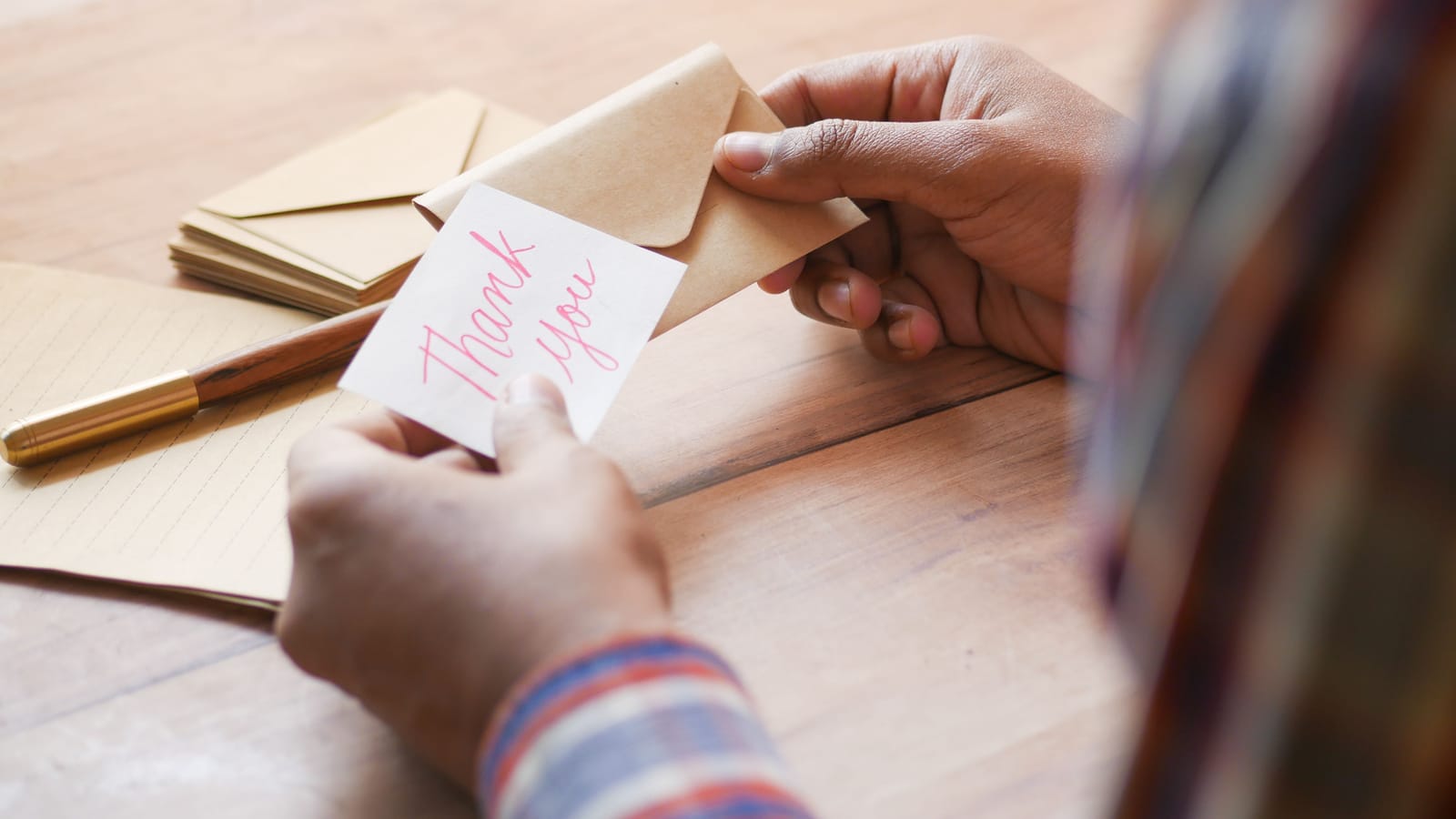
The handwritten note is still undefeated
Three sentences. That's the whole format. What they did, what it meant, and thanks.
Keep a box of blank cards in your desk drawer with a book of stamps sitting on top of them so there's no friction. Send one after a job interview, after dinner at somebody's house, after a man's father dies, after a guy in your trade spends an hour on the phone helping you solve something he could have charged for.
An email evaporates. A card sits on a counter for a month and then goes in a drawer, and eight years later somebody finds it while cleaning out that drawer and thinks about you for a second. I've seen men keep a note from a boss they had in 1998.
You don't need good handwriting. You need to mail it inside a week.
Apologize in one sentence with no escape hatch
"I was wrong about the money and I'm sorry." Done.
Not "I'm sorry if you felt." Not "I'm sorry, but you have to understand." The word "if" and the word "but" are both doors you're propping open so you can back out later, and the other person hears the hinge every time.
Then change the thing. An apology with no adjustment behind it's just a sound.
The one at home that costs the most
Don't correct your wife's story in public.
She says it was Tuesday, it was Wednesday, and there's no version of this where the correction improves anyone's night. Same with her numbers, her route, her account of what the doctor said. Let it ride. Get it straight in the truck on the way home if it actually matters, which it won't.
Courtesy to strangers is easy because strangers are new. Courtesy inside your own house, on day 4,000, when you're tired and you're right, is the hard rep. That's the one your kids are actually watching.
Where this goes wrong
Two ways.
The first is performance. A man who's loudly gracious to the hostess and short with the busboy isn't polite, he's auditioning. Manners pointed only at people who can do something for you're a sales technique, and everybody at the table can smell it.
The second is rigidity. Standing up every time someone walks past your booth at a loud sports bar isn't gallantry, it's theater. Read the room. The point is to make other people comfortable, so if your courtesy is making the room awkward, you've missed it.
And no, none of this substitutes for the bigger things. A man can pull out a chair beautifully and still not pay his bills or keep his word. Manners are the trim, not the frame. But I've never met a man with a solid frame who couldn't be bothered with the trim.
Start with two
Don't try to install all of this by Thursday. Pick two. Stand when someone approaches, and send one note a week. Give it a month and they stop being decisions.
Your son is watching the parking lot version of you, not the church version. Twenty years out he'll put his hand on a door for his wife and have no idea where he picked it up.
You'll know.
Marcus Vale
Editor-in-Chief
Twenty years in magazines, most of it deciding what to cut. Writes about work, discipline and the decisions that compound.

Watch
Worth an hour of your evening
More from Be a Man.
From channels we rate. Plays on YouTube.
Read next