
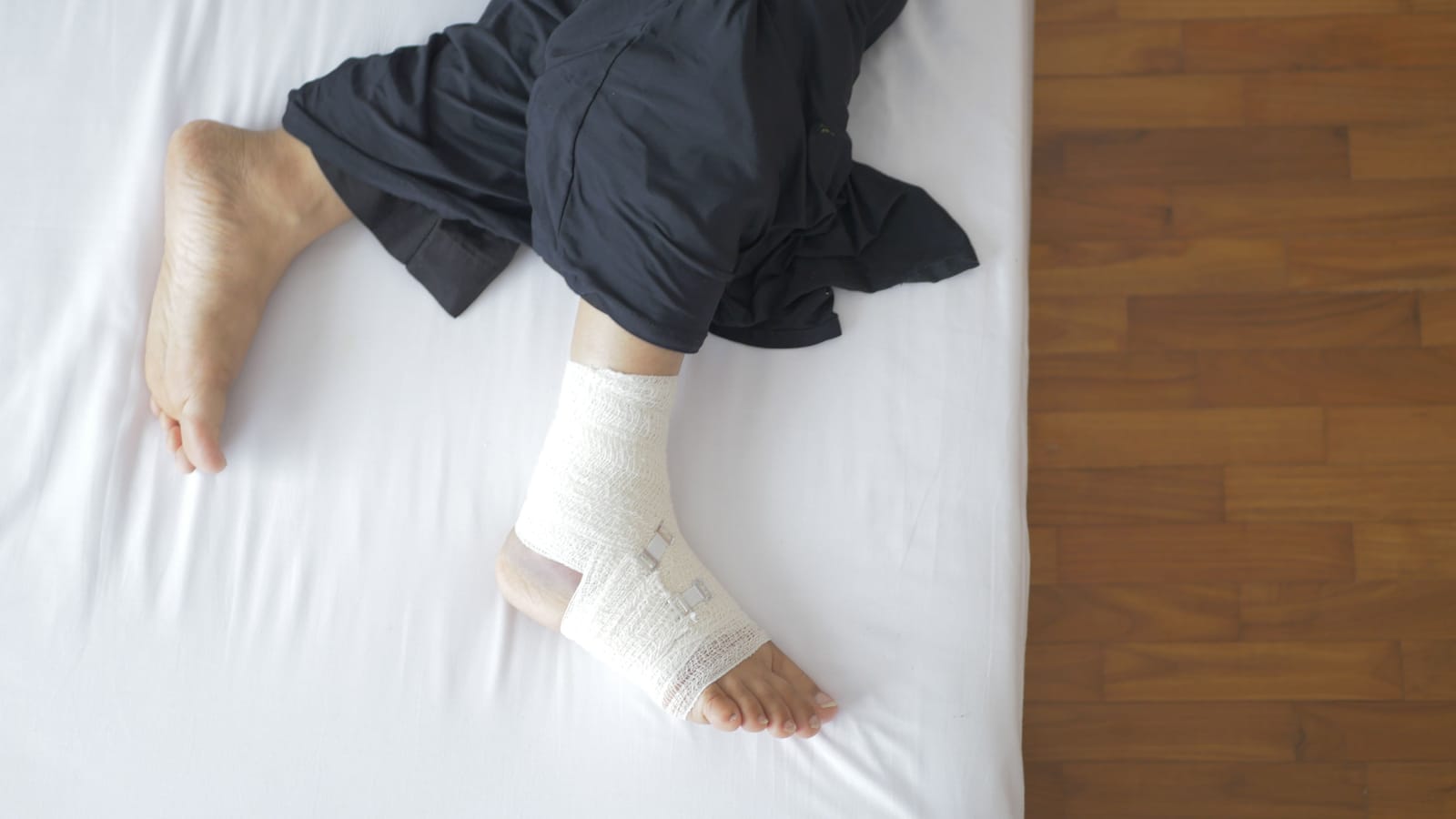
You came off the curb wrong outside the grocery store. Or a kid's scooter was in the dark part of the garage. The ankle rolled in, you saw stars, you hopped around for a minute and told your wife you were fine. By Thursday the swelling's mostly gone and you're walking almost normal.
That's the whole problem. The pain leaves on a two-week schedule and the injury doesn't.
Ankle sprains are the most common thing that happens to the human ankle and the most consistently under-rehabbed. Almost nobody does a single day of actual rehab for one. They wait it out, it stops hurting, they go back to life. Then eighteen months later they roll the same ankle on a surface that shouldn't have been able to do it, and that one takes three months instead of three weeks.
What actually tore
The garden-variety sprain is the inversion kind: foot rolls under you, the outside of the ankle takes it. The ligament that usually goes first is the anterior talofibular, a short strap on the outside front of the joint. It's not a rope. It's more like a seatbelt that also happens to be wired with position sensors.
That second part is what people miss. Ligaments are loaded with nerve endings that tell your brain where your foot is in space without you looking. Tear the ligament and you damage the wiring. The ligament heals over about six weeks, a little longer and a little looser than it was. The wiring doesn't come back by itself. You have to retrain it, and nobody tells you that, because you were handed an ice pack and sent home.
So you end up with an ankle that's structurally almost fine and informationally stupid. It doesn't notice the edge of the sidewalk soon enough to correct. It rolls at a lower force than the first one did. That's the mechanism behind what clinicians call chronic ankle instability, and it's why the second sprain tends to be uglier than the first while the story you tell about it gets more embarrassing.
First, rule out the fracture
Before any of the rehab talk, know when this isn't a sprain.
Clinicians use a short checklist called the Ottawa ankle rules to decide who needs an X-ray. Simplified: get imaged if you can't take four steps on it, either right after the injury or in the exam room, or if you've got bone tenderness right on the back edge or the tip of either ankle knob, or at the base of the fifth metatarsal, the bump on the outside of your midfoot.
Two more that should send you in regardless. Numbness or a foot that looks crooked. And pain above the ankle joint, up in the space between the two shin bones, which can mean a high ankle sprain. That one has a completely different timeline, sometimes months, and it doesn't respond to the plan below. A doctor or physical therapist sorts this out in one visit. None of what follows is a substitute for that visit, especially if the swelling isn't clearly improving by day ten.
The first week, done right
The old advice was rest it, elevate it, stay off it. The rest part has aged badly.
Walk on it as soon as you can walk without a visible limp, using a crutch or a brace early if that's what keeps your gait normal. Limping is the enemy here. A limp teaches your hip, knee and opposite side a movement pattern you'll be undoing in March.
Compression sleeve during the day for the first few days. Elevation when you're sitting anyway. Ice if it makes you comfortable, and don't expect it to change the healing timeline, because it won't.
Start moving the joint on day two or three. Trace the alphabet with your big toe, sitting down, both directions of ankle motion. Do it while a meeting is happening on your laptop. Then get onto the wall stretch for the calf, back knee straight, thirty seconds, a few times a day, because losing ankle dorsiflexion is a quiet way to guarantee the next roll.
The five minutes that actually prevent number two
Balance training is the part with the strongest track record for keeping you from re-spraining, and it takes less time than finding your phone charger.
Stand on the bad leg while the coffee brews. Hands off the counter. Aim for 30 seconds, three rounds. When that's easy, close your eyes. Eyes closed on one leg is where the honest assessment happens, and the first time you try it you'll last about nine seconds and be genuinely annoyed.
After that, make it harder in this order:
- One leg, eyes closed, 30 seconds each side
- One leg while brushing your teeth, on a folded bath towel
- One leg, eyes open, tossing a ball against a wall or reaching to touch the floor in three directions
- Small hops in place on one leg, then hops forward and back over a line of tape
Strength comes alongside it. Calf raises are non-negotiable. Two legs up, one leg down, slow, until you can do 25 clean single-leg raises with your heel getting all the way to the top. Then add the outside-of-the-ankle work: loop a resistance band around your forefoot, anchor it to a table leg, and turn the foot outward against it. Three sets of 15, twice a week. That's the peroneal group, and it's the muscle set that has any chance of catching a roll before the ligament has to.
Eight weeks of this, four days a week, ten minutes a session. That's the whole prescription. Nobody needs a gym, a class or a free evening.
Brace it for a year, and don't be weird about it
If you play anything with cutting in it — basketball, soccer, pickleball, tag with a seven-year-old on a wet lawn — wear a lace-up ankle brace for at least the next twelve months on that side. Bracing after a sprain is one of the better-supported ways to cut re-sprain risk, and it's cheap enough that arguing about it's a waste of your time.
The objection is always the same: won't it make the ankle weak? Not if you're doing the balance and calf work. The brace handles the sudden stuff your nervous system can't catch yet. You handle the rest.
Tape works too, and it's what athletic trainers use, but tape loosens inside about twenty minutes of hard play and you have to re-apply it every time. For a guy with a job, the brace wins on logistics.
Why this matters more than it sounds
Repeated rolling doesn't just stretch ligaments. Each significant sprain can bruise or chip the cartilage on top of the talus, and those lesions are the reason a percentage of people with sprain histories end up with a stiff, aching ankle in their fifties that nobody can quite explain. The arthritis story in the ankle is mostly a trauma story. It doesn't start with wear. It starts with a curb.
Here's the concession: you can do everything in this article and still go over on a gravel shoulder in the dark. Rehab reduces the odds, it doesn't buy immunity. And plenty of people rolled an ankle in high school, never did a thing, and have been fine for twenty years.
But if you've got the ankle that "just goes sometimes," the one you brace out of superstition, that's not a personality trait of your left leg. It's an untreated injury from years ago and it responds to balance work now, at 44, the same way it would have at 24. Slower. Still works.
Test yourself tonight. Stand on the bad side, close your eyes, and count.
Cal Brennan
Fitness
Strength coach. Trains fathers, tradesmen and desk workers, which means programmes that survive a bad week.

Watch
Worth an hour of your evening
More from Fitness.
From channels we rate. Plays on YouTube.
Read next