
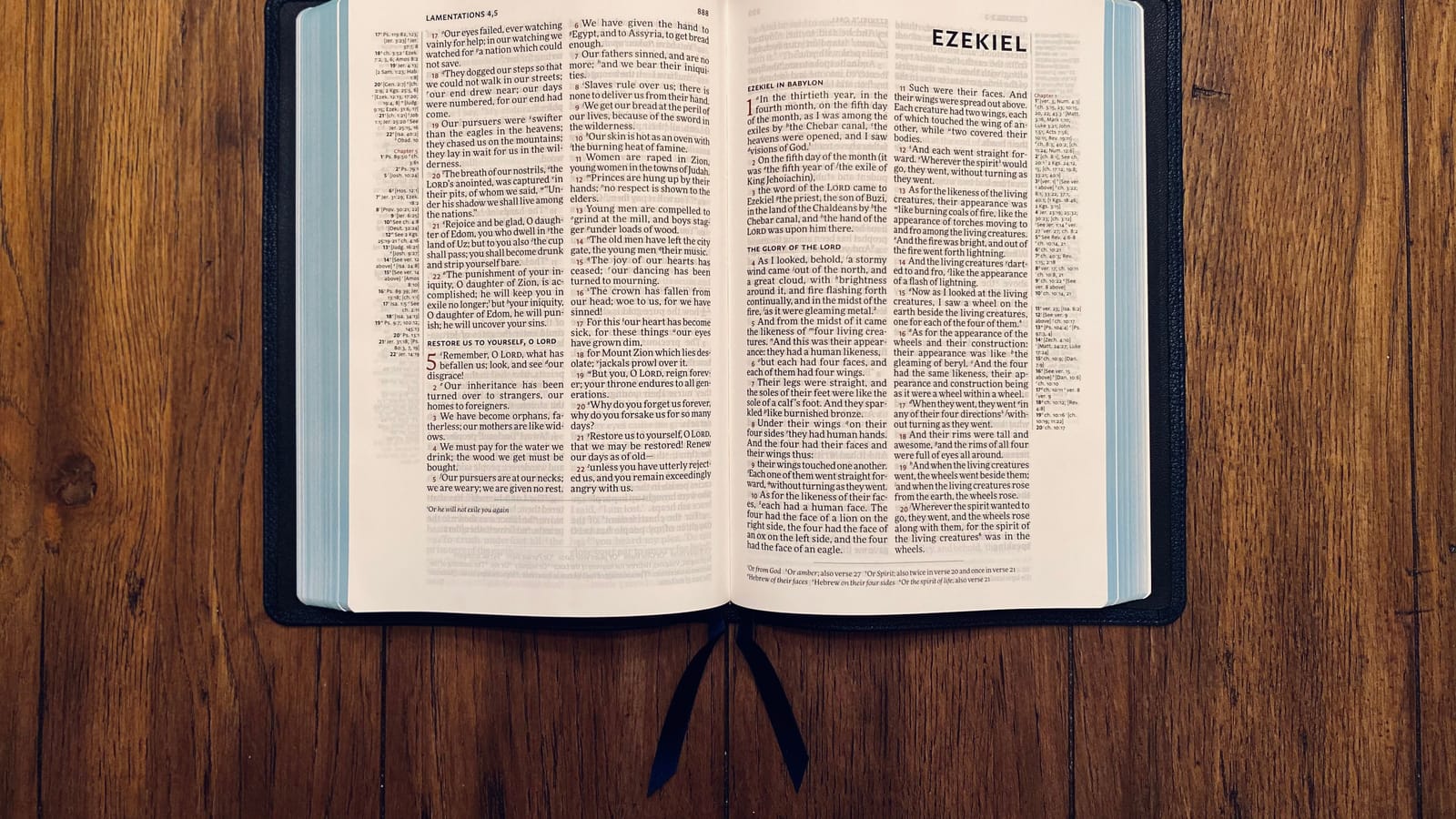
Read Daniel 2 tonight. Forty-nine verses, about eight minutes, and it hands you the frame that every other prophecy passage in the Bible hangs on. A pagan emperor has a dream he can't recall. God gives Daniel both the dream and the meaning. A statue: head of gold, chest of silver, belly of bronze, legs of iron, feet of iron mixed with clay. Then a stone nobody quarried comes flying in, smashes the whole thing, and grows into a mountain that fills the earth.
Notice what the text does next, because this is the habit that will save you a thousand arguments. It interprets itself. Daniel tells Nebuchadnezzar, "You are that head of gold" (Daniel 2:38). Gold is Babylon, named out loud. Four kingdoms, in order, and then a fifth that God sets up and nobody removes.
That's the whole shape of biblical prophecy in one chapter. Human empires, stacked up and impressive, and one stone that ends the argument.
The guy with the laminated chart
You've met him. Church lobby, folding table, a chart with arrows and a date circled in red. He's usually sincere and he's usually reading the news more carefully than he's reading Daniel.
The chart isn't the problem. The date is. Jesus said plainly that no one knows the day or the hour, not the angels, not the Son in His incarnate ministry, only the Father (Matthew 24:36). When the disciples tried one last time to get a schedule out of Him, He told them the times weren't theirs to know and sent them out as witnesses instead (Acts 1:7-8). Every date that's ever been circled in red has come and gone, and every one of them handed skeptics a free punch.
So set the calendar down. Pick up the order of the books.
Four rules, before you read another word
- Take it plainly unless the text says it's a symbol. And it often does say. Revelation 1:20 tells you the lampstands are churches. Daniel 8:20-21 names the ram as Media and Persia and the goat as Greece. When God wants you to decode something, He gives you the key.
- Let the Bible explain the Bible. Revelation is stitched together out of the Old Testament. If a verse there confuses you, the answer is usually in Daniel, Ezekiel, Zechariah or Genesis, not in a magazine.
- Israel means Israel, and the church means the church. Don't quietly swap one for the other to make a passage fit. Read Romans 9 through 11 and you'll see Paul refuses to.
- The subject is Jesus. The book is "the revelation of Jesus Christ" (Revelation 1:1), and the angel tells John that the testimony of Jesus is the spirit of prophecy (19:10). If your study of the end times has stopped being about Him, something's gone sideways.
Daniel gives you the skeleton
Read Daniel 1 through 6 first anyway, even though those are the stories you already know. Lions, furnace, handwriting on the wall. They're there for a reason: they show you people who stayed faithful under a hostile government, which is the actual application of the whole book.
Then chapters 7 through 12, slowly, twice. Chapter 7 replays the four kingdoms as beasts and adds a detail the statue didn't have: ten horns on the fourth, and a little horn that comes up, speaks arrogantly, and wears out the saints for "a time, times, and half a time" (7:25). Hold onto that phrase. You'll see it again as forty-two months and 1,260 days in Revelation.
Chapter 9 is the one worth the effort. Daniel is praying over Jeremiah's seventy years, and Gabriel shows up with seventy sevens: a decree to rebuild Jerusalem, sixty-nine sevens, and then "Messiah shall be cut off, but not for himself" (9:26). Then the city and the sanctuary get destroyed, which happened in A.D. 70. Then one seven is left, and a covenant is made and broken at its midpoint.
That leftover seven is why anybody talks about a seven-year tribulation at all. It isn't a novelist's invention. It's the arithmetic of Daniel 9.
Matthew 24 gives you the sequence
The disciples had just admired the temple stonework. Jesus told them not one stone would be left on another. So on the Mount of Olives they asked Him three things at once: when, what's the sign of Your coming, and what's the sign of the end of the age (Matthew 24:3).
His answer runs fifty-one verses and it's mostly warnings about being fooled. Deception first. Wars, famines, earthquakes, and He calls those the beginning of birth pangs, not the end (24:8). Then persecution. Then the gospel preached to every nation. Then the abomination of desolation, and He tells you where He got the term: "spoken of by Daniel the prophet" (24:15). Then great tribulation, cut short for the sake of the elect. Then false christs so convincing they'd deceive anybody who could be deceived.
And then nothing subtle at all. The sun darkens, the sign of the Son of Man appears, and every tribe on earth sees Him coming (24:30). No sneaking in. No spiritual metaphor you'd need a podcast to catch.
Read Mark 13 and Luke 21 in the same week. Luke adds Jerusalem surrounded by armies and the Gentile times, which is the piece people miss.
Revelation gives you the ending
Revelation frightens people because they open it in the middle. Don't. The book gives you its own table of contents in 1:19: write what you've seen, what's now, and what's going to happen after.
That's chapter 1, then chapters 2 and 3, then everything from chapter 4 on.
Chapters 2 and 3 are seven letters to seven real congregations in what's now western Turkey, and they're the most practically useful part of the book. Lost love. Tolerated false teaching. A church with a great reputation and no pulse. A lukewarm crowd with money who thought they needed nothing. Read those before you touch a single seal.
Chapter 4, John hears "come up here" and the scene moves to the throne room. Chapter 5, the Lamb takes the scroll, and that's the hinge of the whole book. Then judgments in three sets of seven: seals, trumpets, bowls, with interludes. Chapter 13, the beast and his mark. Chapter 19, the rider on the white horse, and the war ends in one verse. Chapter 20, a thousand years. Chapters 21 and 22, no more death, no more sea of separation, no more night.
Where the rapture fits
Here's the position worth holding, and it's held plainly: Christ comes for His church before that seven-year period, and returns to the earth in power at its end. Paul says the dead in Christ rise, the living are caught up, and we meet the Lord in the air (1 Thessalonians 4:16-17). He says it happens in an instant, a twinkling (1 Corinthians 15:51-52). He says God hasn't appointed us to wrath (1 Thessalonians 5:9). Jesus said He's preparing a place and coming back to get us (John 14:2-3). Titus 2:13 calls it the blessed hope, and hope is the right word for it.
Good, serious believers land elsewhere on the timing, and that's a family disagreement, not a test of faith. But notice what Paul does with the doctrine every single time he teaches it. He comforts people with it, and then he tells them to live like it's true. Purify yourself (1 John 3:3). Be found in godliness (2 Peter 3:11). Keep your lamp lit and your work clothes on (Luke 12:35).
What to do about it on a Tuesday
Prophecy isn't a hobby. It's leverage on your own life, and it points straight at the people you love who don't know Christ. There's one door, and He said so Himself: no one comes to the Father except through Him (John 14:6). Salvation is in no other name (Acts 4:12). If that's true, the most urgent thing on your calendar isn't a chart. It's a conversation with your brother-in-law.
Six weeks, if you want a plan. Week one, Daniel 1-6. Week two, Daniel 7-12. Week three, Matthew 24-25 with Mark 13 and Luke 21 alongside. Week four, all eight chapters of 1 and 2 Thessalonians. Week five, Revelation 1-11. Week six, Revelation 12-22. Keep a pen in your hand and mark every promise God makes about what He will do.
For teaching that stays anchored to the text, Jack Hibbs at Calvary Chapel Chino Hills is worth your time. For actually opening your mouth about it, the Way of the Master material will give you a way in that doesn't feel like a sales pitch.
The last prayer in the Bible is three words long, and you can pray it tonight without understanding chapter 13. Come, Lord Jesus.
Cal Brennan
Fitness
Strength coach. Trains fathers, tradesmen and desk workers, which means programmes that survive a bad week.

Watch
Worth an hour of your evening
More from Christian Bro.
From channels we rate. Plays on YouTube.
Read next