
A rule you can't enforce is worse than no rule at all. It teaches your kids that what you say and what happens are two different things, and once they've learned that, they'll test everything else you say too.
So before you write a screen policy, sort your rules into two piles. The ones that hold when you're tired, outnumbered and cooking dinner. And the ones that only hold on a good day. Throw the second pile away.
That usually leaves you with about three rules. Three is plenty.
Why the long list always dies
Most household screen policies fail for the same reason. They're built on you noticing.
Two hours a day sounds reasonable until you try to count it. Was the twenty minutes on the tablet in the car part of it? What about the school laptop, which is technically homework and technically also YouTube? You end up as the family's screen accountant, running a ledger nobody else can see, and every single day ends in a negotiation you're too worn out to win.
Rules that depend on your vigilance decay. Rules that depend on the physical world don't.
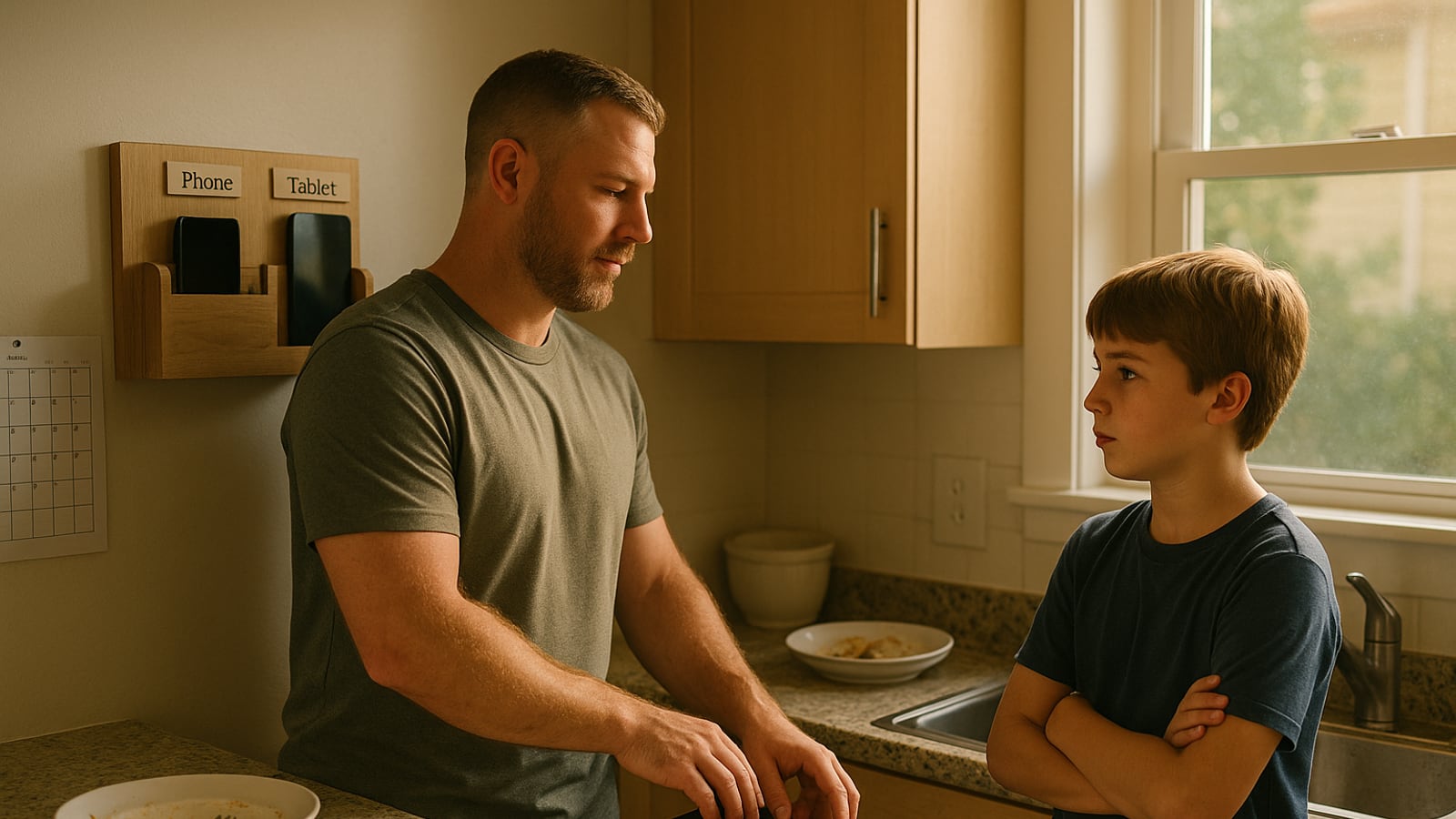
The drawer where phones charge overnight doesn't get tired. The rule that screens don't come to the table doesn't need you to do arithmetic. You can see, in one glance, whether it's being kept.
Build everything around that principle. Place and time, not minutes.
The three that do most of the work
No screens in bedrooms overnight. Everything charges in one spot in a shared room. This is the single highest-value rule in the house and it's also the one that gets the most pushback, because the phone in the bed is where the real damage happens — the two a.m. scroll, the group chat you don't know exists, the content nobody would open in the kitchen. It also wrecks sleep, and a tired child is a worse child at everything.
Buy a cheap alarm clock. That kills the main objection in about nine dollars.
No screens at the table, and that includes yours. Non-negotiable, no exceptions for "I'm just checking the score."
Screens come after, not before. Homework, jobs, outside. Then the screen, if there's time left. This one quietly solves the time problem without anybody counting minutes, because the day fills up and the screen gets the remainder instead of the priority.
You'll notice none of these are about how long. That's deliberate. A kid who watches a film with his sister on a Saturday afternoon is doing something different from a kid alone with a phone at midnight, even if the clock says the same thing.
Your phone is the actual rule
Kids don't learn from your policy. They learn from your behavior, and they're better at spotting the gap than you're at hiding it.
If you check email at dinner, the table rule is dead. If your phone comes to bed, the bedroom rule is a rule for children, which is to say it's a rule about power rather than about what's good. They'll comply and they'll resent it, and the moment they're out of the house they'll do the opposite.
So put your phone in the drawer too. Out loud. "Mine's going in."
This is harder than it sounds because your phone is also your work, your bank and your map. Do it anyway. The cost to you is a few hours of slightly slower response times. The cost of not doing it's the whole framework.
What happens when they break it
Something small, immediate and boring. Not a lecture.
The device goes away for a fixed period you decide in advance and state before anything happens. A day. Two days. Whatever fits the age. The key is that it's known, it's short enough to actually run, and it isn't invented in the heat of the moment by a father who's had enough.
The classic mistake is the enormous consequence. Phone gone for a month. You won't hold it, they know you won't hold it, and when you cave on day nine you've taught them the rules are a bluff. A two-day confiscation you actually complete beats a month you abandon.
Say it once, in a flat voice, and follow through. No moral essay. The point isn't to make them feel bad. The point is that the rule is real.
And don't argue during the consequence. Discussion about whether a rule is fair happens at a calm time, on a different day, when nobody's phone is in the drawer.
The leaks you'll miss
The second device. You take the phone, they use the tablet. Or the sibling's. Or the games console browser, which is an internet browser wearing a hat. Confiscation only works if you know every screen in the house, and there are more than you think.
The school laptop. Genuinely hard. It's required, it comes with fewer restrictions than you'd expect, and "I'm doing homework" is unfalsifiable from the next room. The workable answer is location: schoolwork happens at the kitchen table, not behind a bedroom door. Nobody has to be accused of anything.
Dinner prep. The hour between school and food is when every screen rule in the world gets suspended, because you need forty minutes of quiet and the tablet buys it. This is the honest one. If you're going to do it, name it as a rule rather than pretending it isn't happening. An admitted exception is a rule. An unadmitted one is a hole.
Sickness and long journeys. Same deal. Say out loud that this is a different day with different rules, and say out loud when it ends.
Teenagers need a different deal
At some point the household rule stops working and you need an agreement instead.
With a fifteen-year-old, pick the one or two things you actually care about — probably sleep and probably knowing which platforms they're on — and trade away the rest. Let them have a genuine win. Write the deal down, put it on the fridge, and review it on a date you both agree to rather than whenever there's a fight.
You won't be able to monitor a teenager's phone properly and you shouldn't pretend otherwise. What you can do is stay close enough that they tell you when something goes wrong online. That relationship is worth more than any filter, and every argument you pick over minutes spends a little of it.
Know the platforms they use. Not to spy. So that when they mention something, you know what they're talking about and you don't have to ask four questions that make you sound like a stranger.
The part that isn't about screens
The screen is competing with something. If the something is an empty house and a father on his own phone, the screen wins on merit.
Kids give up devices most easily when there's an obvious better offer in the room. A workshop. A dog that needs walking. A father who'll actually play the game rather than supervise it.
The first ten minutes after you take the tablet away are dismal. They're bored, they're annoyed, and they'll tell you so. Sit through it. Boredom isn't the failure state — it's the thing that has to happen before anything else does.
Sam Ortiz
Dads & Family
Father of three. Writes about presence, discipline and the long game, without pretending any of it's tidy.

Watch
Worth an hour of your evening
More from Dads.
From channels we rate. Plays on YouTube.
Read next