
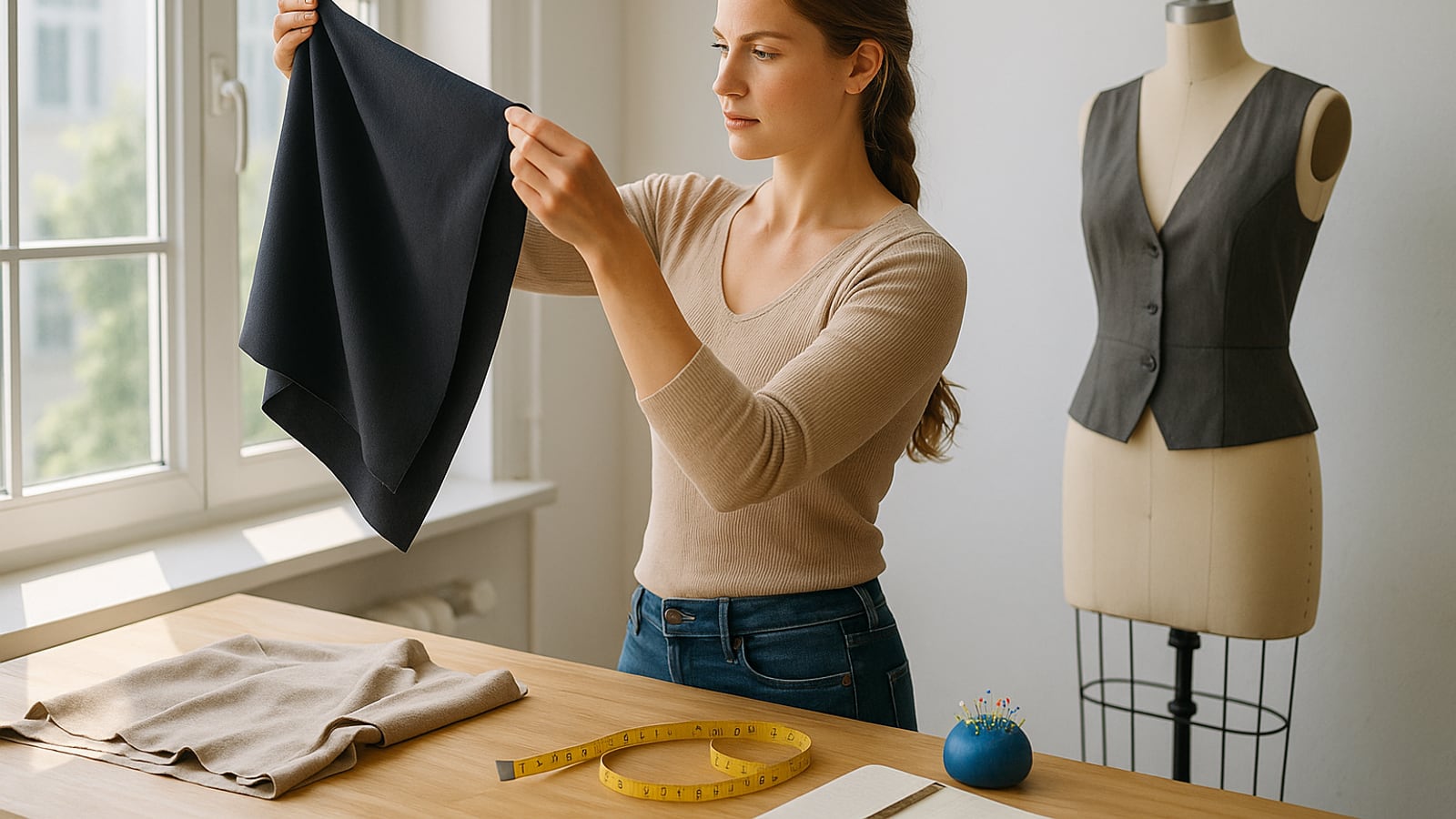
Hold it up to the light before you buy it. Not shop light, which is designed to be kind. Put your hand behind the fabric about eight inches from a bare bulb or a window, and look at the back of your own hand through the cloth. White shirts fail this constantly. So do cream trousers, pale linen, and almost every knit sold under about 200 grams per square meter.
This is the single most common way a perfectly decent outfit goes wrong, and it's the one you can't see in a mirror indoors. You find out at four in the afternoon in a garden, with the sun behind you, when someone kindly mentions it.
So start there. Opacity is a property of the garment, not of your intentions. You check it the same way you'd check a hem.
Structure does the work that shapelessness won't
The thing most "modest" clothing gets wrong is that it treats coverage as a subtraction problem. Longer, looser, more fabric, less shape. What you get is a garment that drapes off the widest point and hangs straight down, which is the silhouette of a dust sheet over furniture.
Sharp comes from cloth that holds a line. Wool crepe, ponte, heavy viscose twill, cotton poplin with some body, mid-weight denim, a proper wool flannel. These fabrics have enough weight to fall away from you instead of clinging, which means they cover more while showing more shape, not less.
Test it in your hand. Grab a fistful of the cloth, squeeze for five seconds, open your palm. If it comes out as a creased rag, it'll cling, wrinkle, and cheapen. If it springs back and hangs, buy it.
Thin rayon jersey is the enemy here. It's cheap, it's everywhere, it's sold in wrap dresses and maxi skirts specifically marketed as modest, and it clings to absolutely everything it touches. A lined skirt in a heavier cloth covers better than a long jersey one.
The sleeve is most of the fight
Long sleeves are hard to buy because most brands don't make them well. Look for a set-in sleeve with a proper shoulder seam that sits on the edge of your shoulder bone. A dropped shoulder gives you coverage and a sloppy line at the same time, which is the worst trade available.
Three-quarter sleeves should end at the narrowest part of your forearm, not halfway down it. Get that wrong by an inch and a good jacket looks borrowed.
The sleeve length to avoid is the one that stops at the widest part of your upper arm with no cuff, no band, no taper. It reads as school uniform. If a dress you otherwise love has it, a tailor can shorten it to a genuine cap or add a band, and that costs less than most alterations.
Long sleeves with a real placket and a cuff you can unbutton and roll are worth paying more for. A rolled cuff is the fastest way to make covered-up look deliberate rather than defensive.
Shirts gape. Fix the shirt.
Button-front shirts pull open at the bust because they're cut from a block that assumes a straight line from chest to waist. This isn't your fault and no amount of standing differently solves it.
Three fixes, in order of how well they work. Buy the shirt a size up and have the side seams and sleeves taken in, which is one of the cheapest alterations a tailor does. Buy shirts with a button placed at the fullest point rather than four inches above it. Or skip shirts and wear a fine-gauge knit with a high crew or a mock neck, which has no opening to gape.
The one measurement you can't fix afterwards is the shoulder. If the shoulder seam sits an inch out onto your arm, put it back. Everything else on a shirt is adjustable.
Skirt lengths, and the one that doesn't work
Just below the knee looks sharp. Mid-calf looks sharp. Full length, brushing the top of the shoe, looks sharp when the fabric has weight.
The awkward zone is the flared skirt that ends at the widest part of the calf with no structure. It's the length most cheap modest skirts default to, and it shortens the whole line.
Two practical points. A midi skirt without a slit is very hard to walk up stairs in, so most have one, and most have it cut deeper than you want. A tailor can close the top three or four inches of a back slit and leave you enough to walk. Say exactly how much you want closed, in inches, while you're standing in it.
And line it. Unlined skirts ride up, cling, and go see-through in strong light. If the skirt you want is unlined, buy a half slip and stop thinking about it. Silk or a good synthetic, in a shade close to your skin rather than white.
The third piece earns its keep twice
A blazer, a waistcoat, a structured cardigan, a good coat. Adding a third layer does two jobs at once here: it covers the shoulders and upper arms, and it's the thing that makes an outfit look composed rather than thrown together.
A single well-cut blazer in navy or charcoal will do more for how you look than five new tops. Check the shoulder, check that the sleeve ends where your wrist bone starts, and get the body taken in if it's boxy.
Waistcoats are underrated. Full coverage at the front, defined at the waist, and they work over a long-sleeved shirt for eight months of the year.
What the modest-specific brands actually do well
Credit where it's due. They make long-sleeved dresses, which almost nobody else does, and they cut skirts with real length and real lining. If you want a sleeved dress for a wedding in July, that's where you'll find it.
What to skip is the layering kit. The thin long-sleeved tee sold in twelve colors to wear under everything, the sewn-in modesty panel at the neckline, the clip-in inserts. They all read as exactly what they are, which is a repair to a garment that was wrong for you to begin with. Buy things that came with sleeves.
The camisole is the exception, because it disappears if you do it right. Match it to the garment above it, not to yourself. Plain jersey or silk, no lace edge, straps you can shorten. A lace-trimmed cami under a blazer looks like underwear showing, because it is.
While you're at it, get properly fitted for a bra. It changes how everything sits across the chest more than any top you'll buy.
Sharp is a maintenance state
You can own the right things and still look rumpled. A handheld steamer takes two minutes and does more than ironing. Keep a lint roller in the car. Get hems fixed the week they drop, not the season after.
Shoes finish it. A clean leather loafer, a boot with the heel tips replaced before they wear through to the nail, a low block heel you can actually stand in for three hours. Scuffed shoes undo a good coat instantly.
Last thing, and it's the one people forget. Pick a color you look alert in and wear a lot of it. Coverage plus black plus black is a uniform, and uniforms are easy but forgettable.
The compliment you're aiming for isn't "that's so modest." It's someone stopping you to ask where you got the coat.
Nina Castellan
BRO for Her
Runs the women-facing desk. Same standard, same tools, written for a different reader — not a softer one.

Watch
Worth an hour of your evening
More from BRO for Her.
From channels we rate. Plays on YouTube.
Read next