
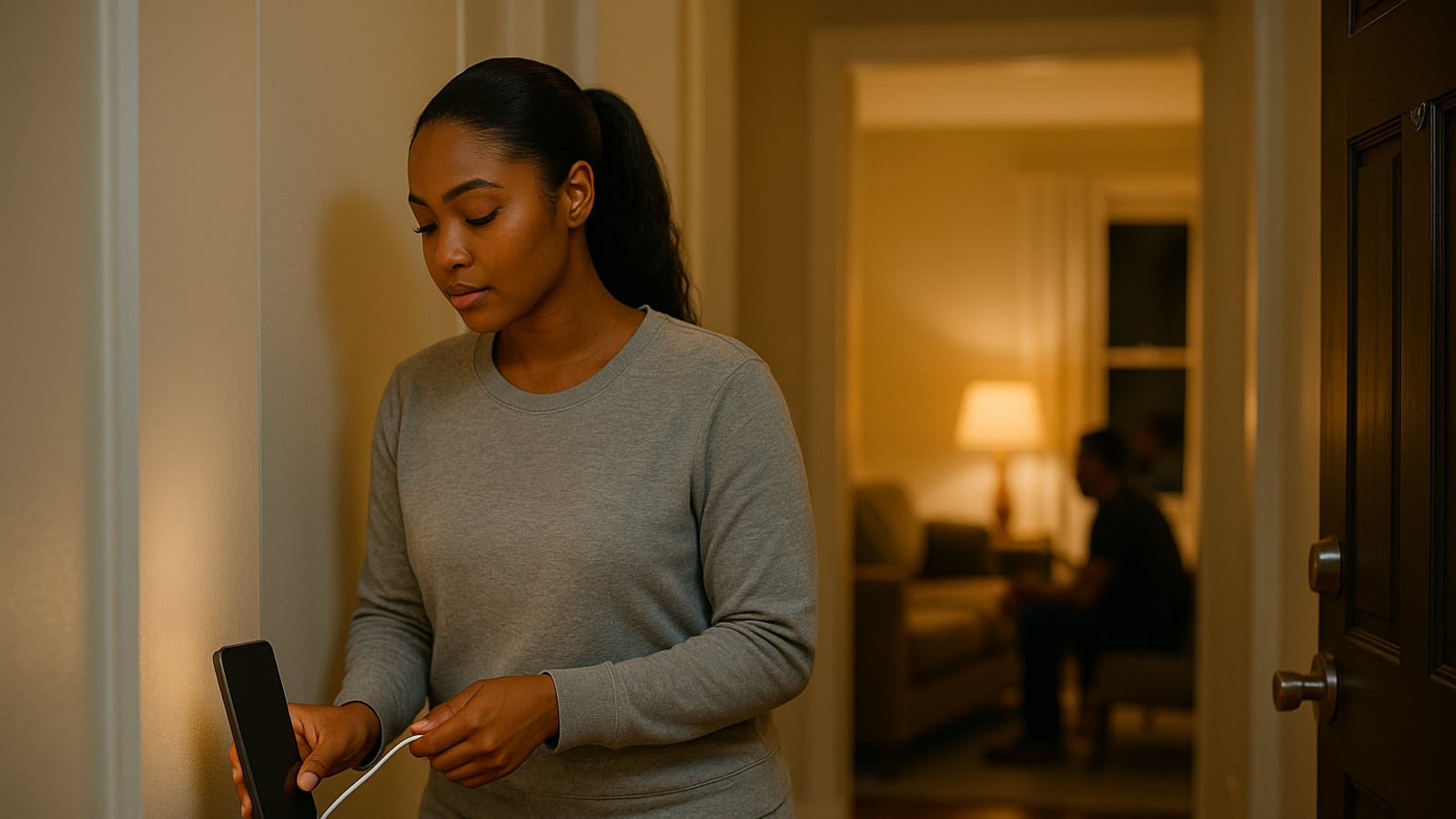
Move the charger.
Not to the other side of the couch. To a room you have to stand up and walk to. Kitchen counter, hallway table, the top of the dresser in the spare room. The single most effective change you can make to your evenings costs nothing and takes about forty seconds, and it works because it converts a reflex into a decision.
Everything else in this piece is downstream of that. But the charger is the one that moves first, because the reason you lost your evenings isn't weakness. It's proximity. The phone is within arm's reach for roughly sixteen waking hours, and no amount of resolve survives that kind of access.
What's actually happening between 7 and 11
You sit down. You're tired in the specific way that makes anything requiring effort feel impossible. The phone is right there, it costs nothing to pick up, and it delivers something mildly interesting within two seconds.
Then it's 10:40 and you've read nothing, watched nothing you'd name, spoken to nobody in your house, and you feel slightly worse than when you sat down.
That's not a character flaw. The products are good. They're built by people whose job is to make the next thirty seconds worth staying for, and they're better at their job than you're at resisting it while exhausted. Treating this as a discipline problem is how people stay stuck for years. Treat it as a design problem and you can actually win.
Make the phone boring before you make it distant
Distance stops the reflex. Boredom stops the return trip.
Turn on grayscale. Settings, accessibility, color filters. The whole screen goes gray. Instagram in gray is a different product — it looks like a spreadsheet of faces. Most people who try this last a week before turning it off, so set it on a schedule instead: gray from 7pm, color in the morning. If your phone supports a shortcut, put it somewhere you'd have to think to reach.
Kill every notification that isn't a human being contacting you directly. Not "manage." Kill. News apps, shopping apps, the bank telling you about a feature, the fitness app congratulating you, the group order reminders. If an app has ever sent you something starting with "Don't miss," it loses notification rights permanently. You'll keep calls, texts, and your calendar. That's most of it.
Clear the first home screen. Phone, messages, camera, maps, and nothing else. Everything else goes into a folder on page two or into search. The extra two seconds of friction is enough to interrupt an unconscious tap.
Put a screen time limit on the two apps that actually eat your evenings. Not all of them — the two. You already know which. Fifteen minutes each. Yes, you can tap through the limit. The point isn't the wall, it's the moment where you have to admit what you're doing.
The phone does real jobs, so replace the jobs
This is where most attempts fall apart. Someone declares a phone-free evening, then discovers the phone was carrying the calendar, the school app, the recipe, the timer, the photos of the kids, the grocery list, and the only way their sister contacts anyone. Two days in, they pick it back up and call themselves undisciplined.
Go through your last week and name the jobs. Then move them.
- Timers and alarms. A cheap kitchen timer and a cheap alarm clock. Ten dollars solves the two most common reasons anyone touches a phone at night.
- The grocery list and the running note. A pad on the counter. Faster than the app anyway.
- Music. A speaker that works without your phone unlocked, or the phone plugged in across the room playing something you chose before you sat down.
- Reading. An e-reader or a paperback. An e-reader with no browser is worth the money purely because it can't become anything else.
- The camera. This one's harder. You will pick the phone up to photograph your kid. Accept it, and build the habit of putting it straight back on the charger. The habit is "photo, then back," not "photo, then just quickly check."
Tell people, once
Some of the pressure isn't the phone. It's a group of people who've learned you reply in under four minutes at 9pm.
Say something simple to the handful who'd notice. "I'm off my phone in the evenings. If it's urgent, call — it'll ring through." Then set your Do Not Disturb to allow calls from favorites, or to let a second call from the same number through within three minutes. Both phones do this. It takes five minutes to set up and it removes the actual fear, which is that something will happen and you won't know.
Then let the group chat wait until morning. It will be exactly as interesting then.
Have something to walk toward
An empty evening with no phone isn't peace. It's twenty minutes of restless boredom followed by a relapse. The habit needs somewhere to go.
Decide before dinner what the evening is. Not a schedule — one thing. Pick a book and leave it open on the arm of the chair. Put the sewing out. Set the puzzle up so you'd have to clear it away to avoid it. Get the walking shoes by the door. The rule is that the thing must be physically visible from where you sit down, because the phone is competing on convenience and you have to compete back.
The first three or four evenings feel long and slightly irritating. That's withdrawal from a very effective product, and it passes faster than you'd think. By the second week the length starts feeling like the point.
The failure modes, named
The time check. You look at the phone to see the time, and eleven minutes disappear. This is why the alarm clock and the watch are worth buying. A watch alone solves an enormous amount.
The bed phone. If the phone charges by the bed, none of the rest holds. This is the non-negotiable one. Whatever else you compromise on, the phone doesn't sleep in the bedroom.
The productive scroll. Answering work email at 9:40 feels virtuous. It isn't. It's the same behavior wearing better clothes, and it teaches your colleagues you're available.
The weekend collapse. Saturday has no structure, so the charger stops being used. Keep the charger rule seven days a week even when the evening rule flexes. The location is the load-bearing part.
Measuring it without an app
Don't check your screen time daily. Check it Sunday, once, and only look at the weekly average. Daily checking turns the phone back into a scoreboard you have to visit.
Better test: at the end of the week, can you name what you did on three of the evenings? If yes, it's working. If you can't remember Tuesday at all, Tuesday went somewhere.
The measure that matters isn't the number of minutes. It's whether the person you live with got a conversation, whether your kid got a parent with her head up, whether you finished the book.
Four hours a night, five nights a week, is most of a working day. You're not trying to be a better person about your phone. You're trying to get a day back every week, and it's sitting right there on the couch cushion next to you.
Nina Castellan
BRO for Her
Runs the women-facing desk. Same standard, same tools, written for a different reader — not a softer one.

Watch
Worth an hour of your evening
More from BRO for Her.
From channels we rate. Plays on YouTube.
Read next