
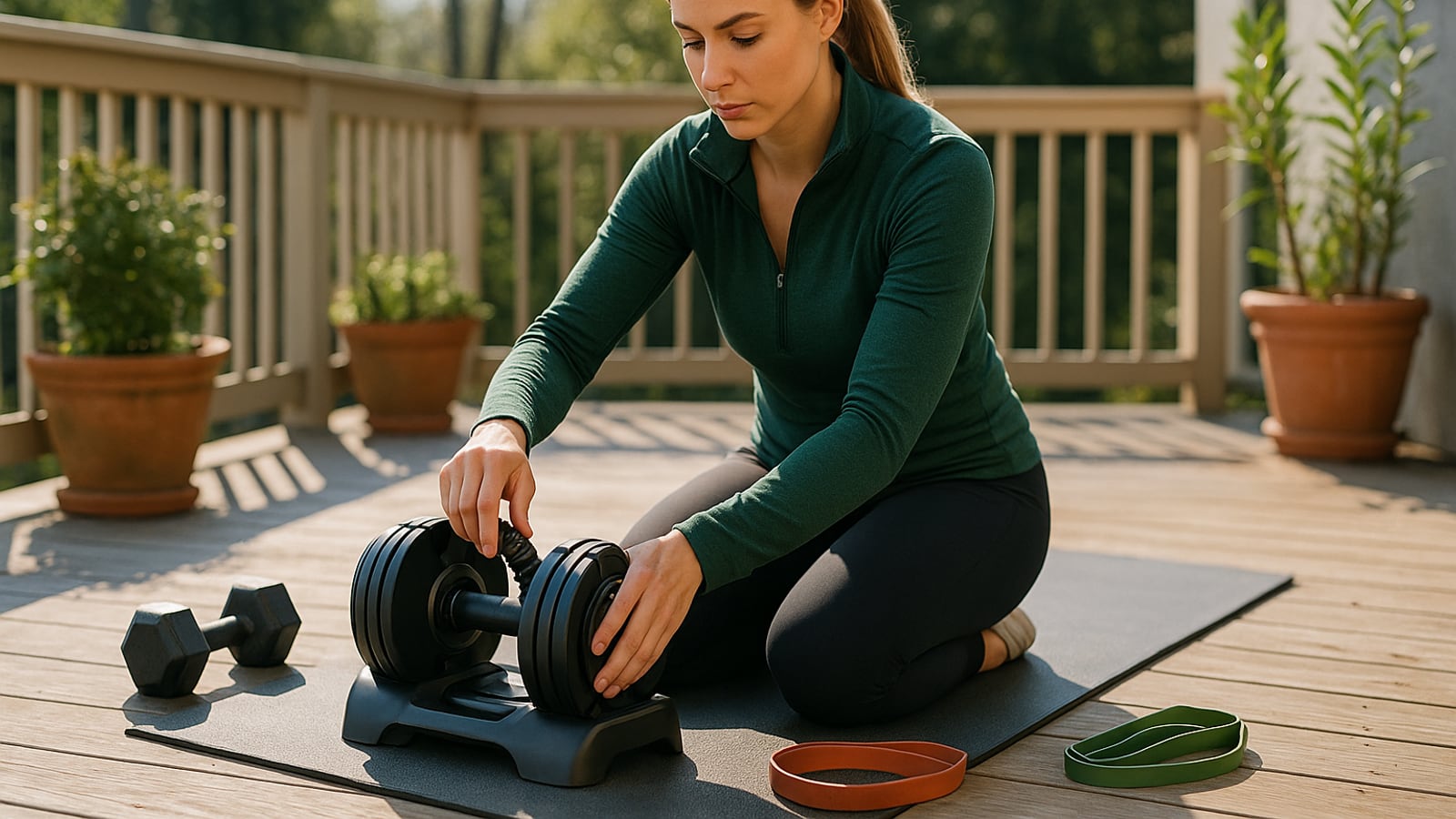
The 15-pound pair you bought in January will be too light by March. That's not a failure. That's the program working exactly the way it's supposed to, and it's the moment most women quit, because the workout still feels like work and the results stop showing up anyway.
Muscle grows when you ask it to do something it can't comfortably do yet. At a gym, you answer that by sliding the pin down another plate. At home, with a rack of hex dumbbells topping out at 25 pounds and a couple of loop bands in a drawer, you have a hard ceiling. Everything below is how to keep raising the demand without buying a barrel of iron every eight weeks.
Buy for the bottom half first
Your arms and shoulders will be happy with light weight for a long time. Your hips and legs won't. A glute bridge with a 20-pound dumbbell on your hips is a warm-up, not a set.
So when you're choosing what to own, weight the purchase toward the legs. One pair of adjustable dumbbells that climbs to 50 pounds each beats five pairs of fixed ones at 5, 10, 15, 20 and 25. Fixed hex dumbbells run roughly a dollar to a dollar and a half per pound depending on what the steel market is doing that month, which means a 50-pound pair costs about what a decent adjustable set does, and the adjustable set gives you every stop in between.
The concession: adjustable dumbbells are slower to change, they rattle, and if you drop one, you'll be hunting for a plastic selector pin under the couch. Fixed weights are better tools. They're just worse value in a spare bedroom.
Bands aren't a substitute for that. They're a supplement, and they're excellent at a few specific jobs.
What bands are actually good for
A band gets harder as it stretches. That's the whole physics of it, and it means a band is strongest at the end of the movement and nearly useless at the start.
That's perfect for things that are hardest at the top. Pull-aparts, where you start with the band slack across your chest and finish with your hands out wide. Face pulls anchored at a door hinge. Banded hip thrusts, where the top of the rep is the part that counts. Monster walks, lateral steps, anything for the outside of the hip.
It's backwards for a squat. A squat is hardest at the bottom, which is exactly where the band goes slack and gives you nothing. If you've done banded squats and thought "that felt like almost nothing," you weren't imagining it.
Where bands earn their keep next to dumbbells is as a top-end add-on. Loop a light band under your feet and over the dumbbells on a goblet squat or a press, and you've got resistance that builds through the part of the rep you're strongest in. That's real. Just don't use it as your only source of load.
And check your bands. A nick in the rubber becomes a snap at the worst possible second, usually near your face. Run them through your fingers before you anchor anything, and never anchor to a door that somebody else might open.
Six ways to make 25 pounds feel like 45
This is the part that saves your training. All of these increase difficulty with zero added weight.
Go one-legged. A 25-pound dumbbell in each hand is 50 pounds across two legs on a squat. Put it into a Bulgarian split squat with your back foot on the couch and you're loading one leg with the same weight plus most of your body. Single-leg Romanian deadlifts do the same thing for your hamstrings and, as a bonus, expose the side of your hips that's been coasting.
Slow the lowering. Take four full seconds to descend on every rep. Count it out loud if you have to. A 12-rep set of push-ups at that tempo is a different animal than a fast 12, and your muscle can't tell the difference between time under load and heavier load. It just knows it's in trouble.
Pause where it's hardest. Two seconds at the bottom of a split squat, dead still, no bounce. You lose the elastic rebound and you're forced to start from a genuine dead stop. Most people drop three or four reps off their number the first time they try it.
Add range. Stand on a couple of stacked books for a Romanian deadlift and take the dumbbells below your feet. Do push-ups with your hands on the dumbbell handles so your chest can sink below your palms. More distance, same weight, harder set.
Shrink the rest. Take a workout you already do and cut the rest from 120 seconds to 60. Same weight, same reps, considerably more misery. This one's finite, so don't lean on it forever, but it buys you six to eight weeks.
Then just do more reps. Twelve becomes 15 becomes 20. Sets of 20 with a weight that's genuinely hard at 20 will build muscle. The research on this settled years ago. The catch is that the last three reps have to be ugly, and most people stop when it starts to burn instead of when the bar speed dies.
The pull problem
Home training is easy for pushing and nearly impossible for pulling, which is why so many home-trained women end up with a strong front and a rounded upper back.
Fix it deliberately. Single-arm rows with a knee on a chair, taken heavy and slow. Band rows anchored low, squeezing for a full second at the chest. If you own a doorway pull-up bar and a sturdy frame, add ring rows or a bar hanging every session, even if you're nowhere near a pull-up.
Rough rule: for every set of pressing you do, do two sets of pulling. You will never regret it, and your neck at 55 will thank you.
What goes wrong in a spare bedroom
Dropped dumbbells crack laminate. Put down a rubber mat or a folded moving blanket, and don't train over a downstairs neighbor's bedroom.
The couch-based split squat drifts. Your back foot slides, the angle changes, and suddenly your knee's in a spot it doesn't like. Use a bench or a hard chair with the seat against the wall.
Hip thrusts off a sofa edge will grind your shoulder blades raw. Wrap a towel around the edge, and put a folded mat between the dumbbell and your hip bones or you'll have bruises you have to explain.
Keep a log on your phone. Not a journal, a list. Date, lift, weight, reps. If this week's numbers don't beat last month's on at least one line, you didn't train, you exercised.
When to stop improvising
There's a point where tempo tricks and single-leg work stop covering for a lack of iron. You'll know it. Your sets of 20 feel like conditioning, your hips aren't sore anymore, and the log has been flat for six weeks straight.
That's a buying decision, or a gym membership. A pair of 50s or a barbell and a few hundred pounds of plates opens the next two years. Nothing about training at home is a permanent identity.
Until then, you have more room than you think. Most women who've owned dumbbells for a year have never once taken a set to the point where the next rep genuinely wasn't going to happen.
Try it Tuesday. Pick the split squat. Find out where the floor actually is.
Nina Castellan
BRO for Her
Runs the women-facing desk. Same standard, same tools, written for a different reader — not a softer one.

Watch
Worth an hour of your evening
More from BRO for Her.
From channels we rate. Plays on YouTube.
Read next