
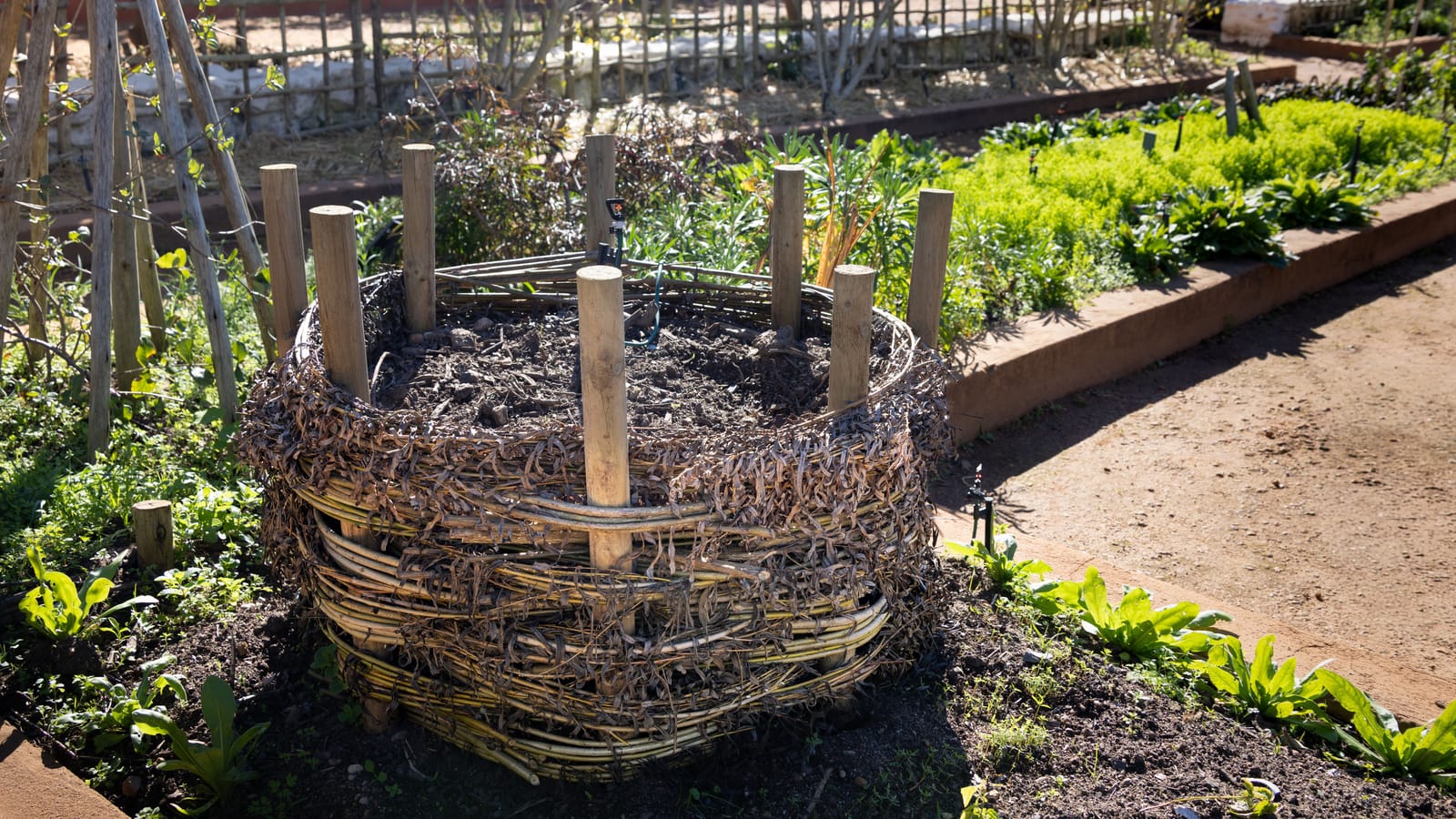
A compost pile that smells is a pile with too much wet green stuff and not enough dry brown stuff. A compost pile with rats is a pile with meat, grease, or cooked food in it, sitting on bare dirt with no wire underneath. That's the whole diagnosis. Everything else in this piece is detail.
Get the ratio right and screen the bottom, and you can run an open bin ten feet from your back door for years and never think about it again. Get it wrong and you'll be standing in the yard on a Saturday morning in June, lifting a lid, looking at a smooth-walled tunnel about two inches across at the base of the pile, wondering how long that's been there.
Browns and greens, and why the ratio is the whole game
Browns are dry and carbon-heavy: fall leaves, shredded cardboard, straw, wood chips, paper egg cartons, sawdust from untreated lumber. Greens are wet and nitrogen-heavy: grass clippings, kitchen scraps, coffee grounds, spent pea vines, weeds you pulled before they seeded.
Aim for roughly three parts browns to one part greens by volume, not by weight. Eyeball it. A gallon bucket of kitchen scraps wants about three gallons of shredded leaves on top of it.
Too many greens and the pile goes anaerobic. That's the sour, ammonia-and-garbage-can smell, and it's the smell that carries over a fence. Too many browns and nothing happens at all. The pile just sits there being a pile of leaves, which is boring but harmless.
If you only remember one thing: when in doubt, add more browns. A pile that's too dry is a slow pile. A pile that's too wet is a problem with your neighbors.
Stockpile leaves in October or you'll be stuck all summer
This is the mistake almost everyone makes. Browns arrive once a year, in the fall. Greens arrive every single day, all summer, from your kitchen and your mower.
So in October, when the maples drop, run the mower over the leaves and bag them. Fill six or eight contractor bags and stack them behind the shed. Shredded leaves take up about a quarter of the space whole leaves do and they break down far faster.
Come July, when you've got two gallons of cucumber peels and a bucket of grass clippings, you reach into a bag and pull out your browns. Without that stash, you're buying straw bales in August or letting the pile go sour.
Cardboard works as a backup. Tear it into pieces about the size of your hand, pull off the tape and the shipping labels, and soak it in a wheelbarrow of water for ten minutes first. Dry cardboard in a pile is just insulation.
Rat-proofing is a hardware problem, not a habit problem
Rats don't come for your banana peels. They come for calories that are dense and familiar: meat, fish, bones, cheese, butter, bacon grease, leftover lo mein, the fatty end of a rotisserie chicken. Keep all of it out. Every bit. If it came off an animal or out of a pan with oil in it, it doesn't go in the compost.
Then do the hardware.
- Quarter-inch galvanized hardware cloth on the bottom. Not chicken wire. A rat chews through chicken wire like it's a screen door. Expect to pay somewhere in the thirty-to-fifty dollar range for a roll that'll floor two bins.
- Cut it four inches oversize on every side and fold the excess up inside the bin walls. Rats dig at the seam where wire meets wood.
- A lid, and a real one. Plywood with a cinder block on it counts. An open pile is an invitation.
- Wrap the sides too if you've had rats before or you back onto a creek, an alley, or a restaurant lot.
Bury every load of kitchen scraps. Open a hole in the center with a garden fork, drop the bucket in, pull browns over the top so nothing food-shaped is visible or smellable from the surface. Four to six inches of cover is plenty.
Size, because a small pile never heats
A pile smaller than about three feet on a side can't hold its own heat. It'll compost eventually, cold and slow, over a year or more. That's a legitimate choice if you're patient and you only have a few scraps a week.
If you want finished compost in a season, build to three feet cubed or a little bigger. Three shipping pallets screwed into a U shape, hardware cloth on the floor, a fourth pallet on hinges for the front. Free if you ask around at a building supply yard, an afternoon to build, and it'll outlast two plastic tumblers.
Tumblers run roughly $120 to $250 and they're genuinely rat-proof because they sit off the ground on a frame. The trade-off nobody mentions on the box: most of them are too small to heat up, and they get heavy enough that a full drum is hard to turn. They're good for a townhouse with a small yard. They're not good if you're feeding a 400-square-foot vegetable garden.
Zone and season change the job
North of about Zone 6, your pile shuts down when overnight lows sit below freezing for weeks. It doesn't die. It freezes solid and resumes in March. Keep adding through winter, keep covering with browns, and expect nothing until the thaw. Build it bigger in fall so the mass carries some heat into December.
Zone 8 and south, and especially the dry West, your problem is the opposite. The pile dries out and stalls. Check moisture weekly in summer. Grab a handful and squeeze: it should feel like a wrung-out sponge, with maybe a drop or two coming out. If it's dusty, water it with a hose while you turn it.
Spring is the easy season everywhere. Grass clippings arrive at exactly the moment you still have leaves left. That combination cooks fast. A well-built spring pile can hit 130 to 160 degrees within a week, which is hot enough that steam comes off it when you open it on a cool morning.
What actually goes wrong
It smells like ammonia. Too much nitrogen. Fork in browns, a lot of them, and turn.
It smells sour and rotten. Too wet, no air. Turn it and mix in dry material. If it's sitting in a low spot, move the bin.
Nothing's happening. Too dry, too small, or too many browns. Water it, add a bucket of grass clippings, turn it.
Flies. Exposed food scraps. Bury them deeper and cover better.
Ants everywhere. The pile's too dry. Water it.
A tunnel at the base. Something with meat or grease got in, or the floor isn't screened. Pull the pile apart, screen the bottom, rebuild, and stop putting the offending item in.
It's full of tomato seedlings next spring. Your pile never got hot. Either accept the volunteers or build bigger and turn more.
Turning every two or three weeks with a garden fork is enough for most people. Every week if you're in a hurry. Never, if you don't mind waiting a year. The microbes don't have a deadline and neither do you.
The first time you fork open a finished pile and it's dark, crumbly, smells like the floor of a forest, and you remember it used to be coffee grounds and a busted jack-o'-lantern, you'll stop thinking of it as yard chores.
Wes Dunbar
Country & Skills
Grew up on an acreage and never quite left. Covers trucks, trades, land, and how to do the thing yourself.

Watch
Worth an hour of your evening
More from Garden & Yard.
From channels we rate. Plays on YouTube.
Read next