
Close the book and write down what you remember
Rereading your notes feels like studying and isn't. The fix takes a blank sheet of paper and about twenty minutes a night.
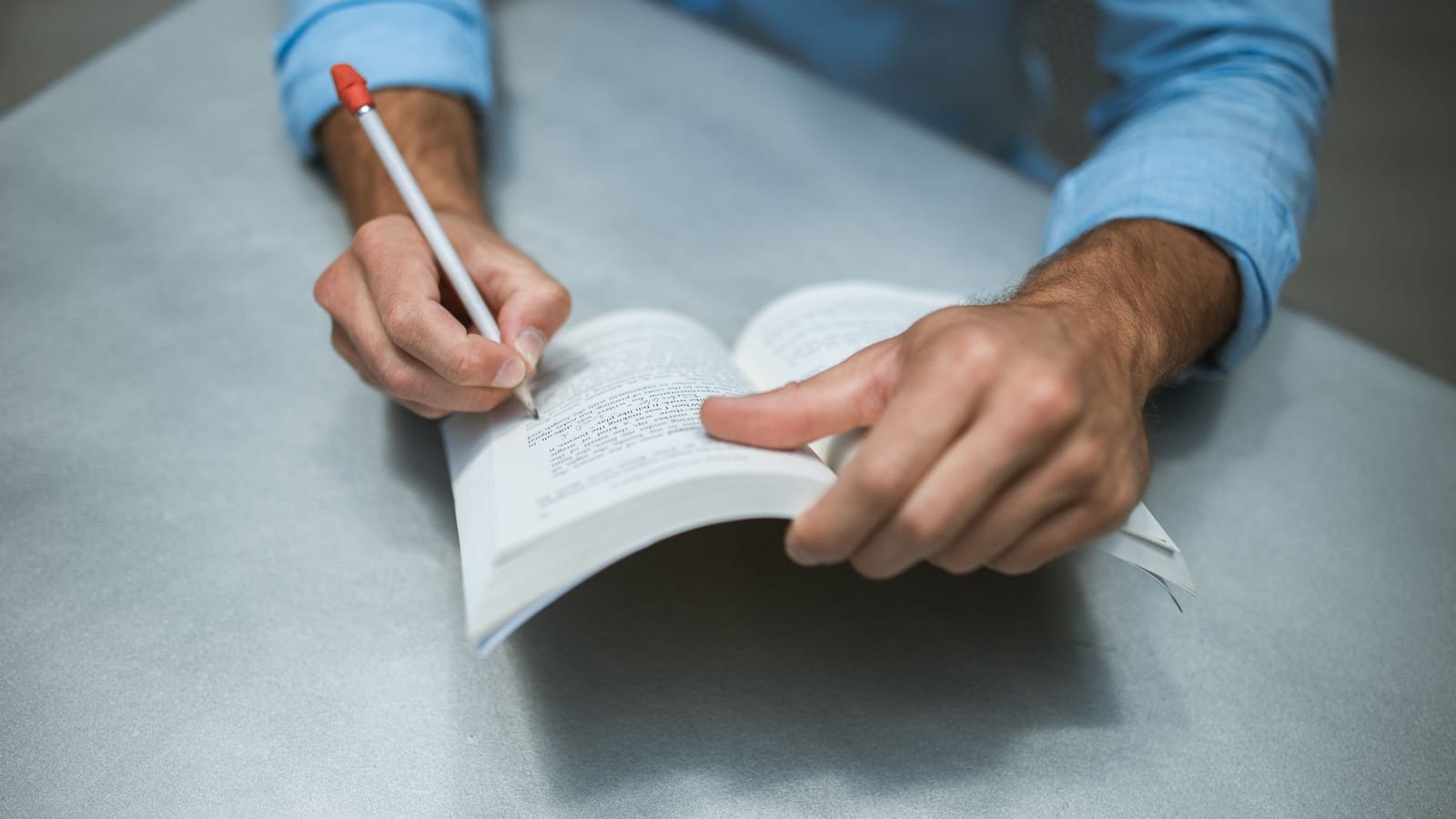
Close the book. Get a blank sheet of paper. Write down everything you can remember about the chapter, from memory, with nothing in front of you.
That's the whole trick. It feels terrible the first time, which is exactly why it works.
Most guys study by reading their notes again. Then highlighting. Then reading the highlighted parts. By the third pass the words feel familiar and smooth, and your brain reads that smoothness as "I know this." You don't know it. You recognize it. Recognition is what happens when you see the answer sitting on the page next to you. A test asks you to produce the answer out of nothing, in a cold room, with a clock running. Those are two different skills, and you've been practicing the wrong one.
The blank page, step by step
Pick one topic. Not a whole unit, one topic. The causes of the Civil War. Balancing equations. The unit circle.
Set a timer for ten minutes. Put your phone in a different room, not face down on the desk. Face down still works on you.
Write what you remember. Terms, definitions, steps, a rough diagram, the three things the teacher kept repeating. Don't organize it. Just dump.
When the timer goes, open the notes and grade yourself with a different color pen. Circle what you got wrong. Add what you missed entirely. Those circles are your study list. Everything else, you already know, and you should stop spending time on it.
Tomorrow, same topic, blank page again. You'll get more, faster. The gaps shrink in front of you, which is the most motivating thing about this method. Rereading gives you no feedback at all. You can reread for two hours and have zero evidence you learned anything.
Four short sessions beat one long one
Three hours the night before a test will get you through the test. It won't get you through the final in May, and it definitely won't get you through the next class that's built on top of it.
Spread the same three hours out. Twenty-five minutes Monday, Tuesday, Wednesday, Thursday. Test Friday. Same total time, completely different result, because every time you let the material get a little fuzzy and then pull it back, the memory gets harder to erase. Forgetting a bit between sessions isn't a problem. It's the mechanism.
The practical version: look at the calendar the day the test gets announced. Count backward. Put four short blocks in whatever you use for a schedule, even if it's a sticky note on your monitor. Twenty-five minutes is nothing. It's half a practice.
One honest trade-off. If the test is tomorrow morning and you've done nothing, spacing is useless to you now. Cram, do the blank page thing twice with a break in between, and get some sleep. Then take the L on the learning and start earlier next time. I'm not going to tell you cramming never works. I'm telling you it rents the information instead of buying it.
Write the test before your teacher does
Teachers telegraph everything. The thing said twice. The thing on the review sheet. The thing that took a whole class period. The example worked on the board that everybody copied.
Go through your notes once, and instead of highlighting, turn every one of those into a question. Write them on the left side of a page, answers on the right, then fold the page so you only see the questions.
Good questions sound like the test. "Why did X happen" and "what's the difference between X and Y" and "walk through the steps to solve this." Bad questions are the ones you can answer with a single word you'd recognize anyway.
For vocab, formulas, dates, and foreign language, index cards are hard to beat. Real cards, written by hand. Writing them is half the studying. Keep the ones you miss in a separate pile and hit that pile twice as often.
For essay subjects, cards are close to worthless. You can't flashcard an argument. Instead, write the opening paragraph of an answer to a question you invented, in ten minutes, by hand, closed book. Then compare it to your notes. That's the real rehearsal.
Say it out loud to an actual human
Find your little brother, your mom, a friend in a different class, the dog if that's what's available. Explain the topic out loud with no notes, like you're teaching it.
You will crash. Around the second sentence you'll hit a spot where you say "and then it kind of, um," and that spot is the exact thing you don't understand. Mark it. Go look it up. Come back and explain it again from the top.
This is the fastest gap-finder there is, and it costs nothing. It also has a side effect worth having: being able to explain something clearly is a skill that pays for the rest of your life, in job interviews, on teams, in every room where somebody has to make a decision and needs it in plain words.
Practice under the conditions you'll actually face
If the test is closed-book, timed, and handwritten, then at least one of your study sessions should be closed-book, timed, and handwritten. Sit at a desk. No music with words. Phone in the other room.
Guys who study lying on the bed with a podcast going and then take the test in silence at a desk are surprised every time. Your brain learned it in one setting and got asked for it in another.
Do the practice problems your teacher gave you as if they were graded. Don't peek at the worked solution after thirty seconds of struggle. The struggle is where the learning happens. Give it a real try, get it wrong, then look. Getting it wrong first and then seeing the right answer sticks better than reading the right answer cold.
The night before is for sleep, not heroics
Sleep is when your brain files what you learned. Staying up until 1 a.m. to review is trading the thing that locks memory in for a few more foggy repetitions. Bad trade.
Light review, twenty minutes, then out. Eat something in the morning. Get there early enough that you're not sprinting in.
And walk in expecting to know it, because if you did the four sessions, you do.
The part nobody puts on a study guide
There's a version of this where you skip all of it, get the answers from someone who took the test earlier in the day, and score a 94. It happens in every school in America.
Don't. Not because you'll get caught, though you might. Because the guy who does that's building a habit of looking capable instead of being capable, and that habit follows you into jobs where the gap shows up fast and in public. The whole point of high school isn't the transcript. It's that you learn how to make yourself learn hard things, on purpose, when nobody is checking.
Start with one blank sheet of paper tonight. Ten minutes. You'll know more about what you don't know than two hours of highlighting ever told you.
Ade Fisher
Young Men
Teaches the trades intake at a community college. Writes the manual he wishes his students arrived with.

Read next