
The case
My wife, Dana, and I had been married eleven months when the dishwasher went to court. I rinse every plate until it squeaks, then load it like I'm packing a moving truck for a cross-country trip. Dana scrapes the plate into the trash, drops it in the rack and walks away. Every night I'd quietly reload her half. Every night she'd watch me do it with the face of a woman being extremely patient.
Then there was the matter of the forks.
We took it to Grandma at Sunday dinner. Grandma has run a house for fifty-one years, fed four kids out of one sink and never once said "agree to disagree." She heard the facts, set down her coffee and said, "Somebody hand me a dirty plate."
Exhibit A
I'll argue my side fairly, because I believed every word of it.
Rinsing. You don't put a plate of dried gravy into a sealed box and hope. My parents had a dishwasher that would bake scrambled egg onto a plate like glaze on a pot. I grew up rinsing because rinsing worked.
Forks handles up. You unload by grabbing the handle, so nobody touches the end that goes in somebody's mouth. It's just hygiene.
Packing it tight. More dishes per load means fewer loads. Fewer loads means less water and less detergent. I wasn't being fussy. I was being efficient. I said that word at the table with a lot of confidence.
Exhibit B
Dana made her case calmly, which is always a bad sign for the other side.
Rinsing. If I run the hot tap over every plate for a minute and then the machine washes it again, I've washed the dishes twice. The whole reason people buy a dishwasher is to stop doing that. She'd also read the detergent box, which says the stuff is built to break down food. Rinse off all the food and you've given it nothing to work on.
Forks handles down. The dirty end should be the end facing the spray. Put spoons in head-down and they nest together, and you get oatmeal fossils.
Packing. Plates jammed shoulder to shoulder block the water. She'd unloaded more than one "clean" bowl with cereal still on it, from my side of the rack.
And then, very gently: "When you reload my half every night, it feels like a performance review."
The table went quiet. My grandfather took a long sip of iced tea.
Grandma's ruling
"I washed dishes by hand for twenty-two years," Grandma said, "at a sink facing the clothesline, in a kitchen that got to ninety degrees by August. Your grandfather bought me a dishwasher for our twenty-fifth anniversary and I cried. I'd have taken that machine over the silver any day."
Then she ruled.
On rinsing, Dana wins. "It's called a dishwasher. If you wash the dishes first, you're the dishwasher and it's a very expensive drying rack. Scrape. Don't bathe." The one exception she allowed me: if the load won't run until tomorrow, or it's egg, oatmeal or melted cheese, give it a quick soak or run the rinse-only cycle so nothing dries into cement.
On the forks, Dana wins again, with an amendment. Eating end up, mixed so the spoons don't cuddle. "Spoons are like puppies. Leave them alone and they pile up." My hygiene worry got answered the old-fashioned way: whoever unloads washes their hands first. "If your hands aren't clean enough to touch a fork, they aren't clean enough to touch my plates, either."
Knives point down. Always. Both of us already agreed on that, and she said it with no smile at all.
On packing, I get half a point. Where things go matters a great deal. My problem was how much I crammed in. "Water goes where it's aimed, honey. If it can't reach the plate, the plate's just along for the ride."
And on the reloading, she looked straight at me. "A man who reloads the dishwasher has volunteered to load the dishwasher. Congratulations on your new job. Dana cooks, you load, and you load it her way until she says otherwise." Then she reached over and squeezed my hand, because that's how Grandma delivers a sentence.
Court adjourned. Somebody brought her pie.
The practical part
What Grandma's kitchen runs on, step by step, for tonight's load:
Before you load
- Scrape, don't rinse. A rubber spatula or a used napkin into the trash. Soak only the stuck-on breakfast foods, or use the rinse-only cycle if the dishes will sit overnight.
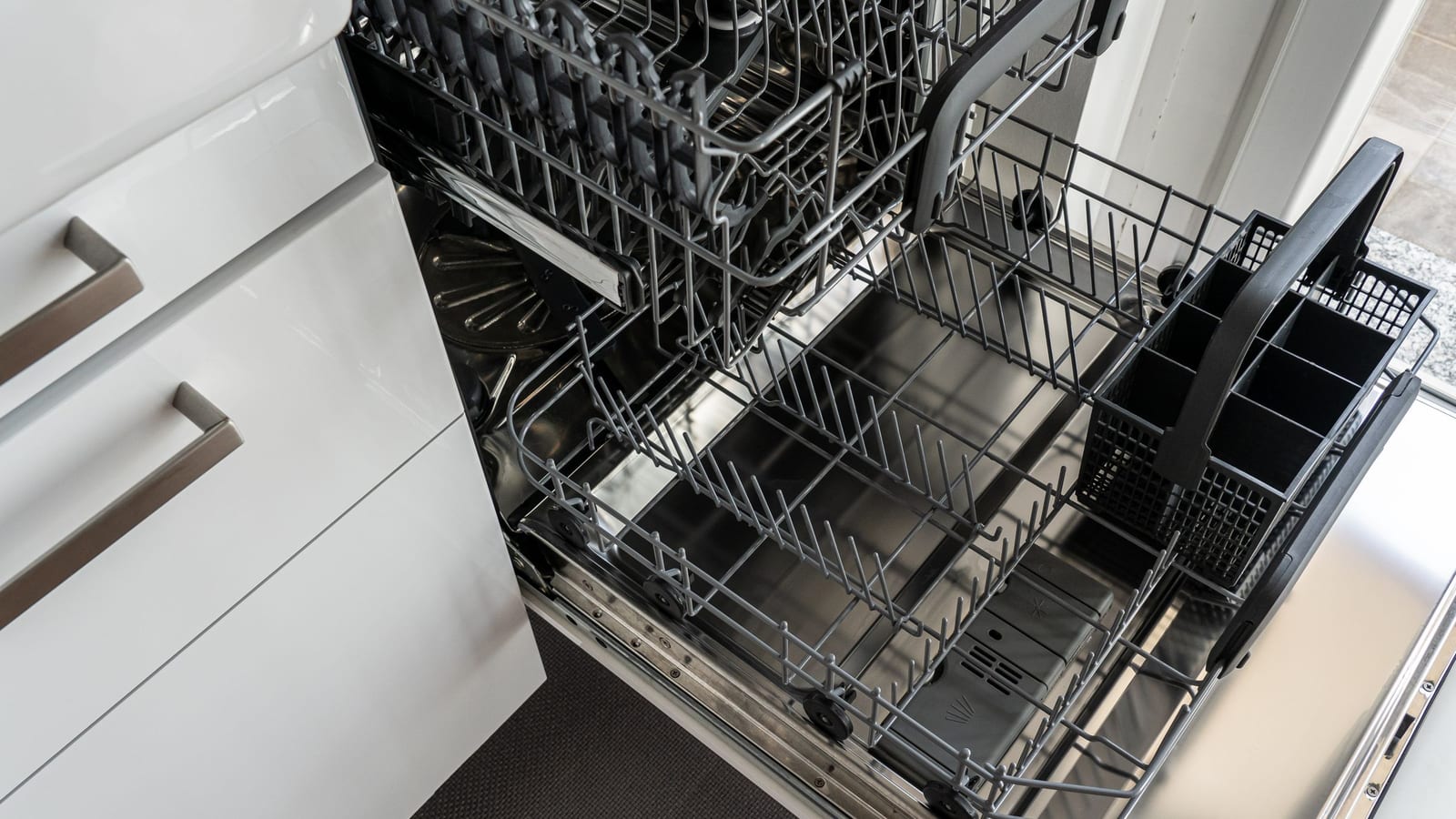
- Flick the spray arms. They should spin freely. A tall pan or a cutting board hanging down through the top rack will stop the bottom arm, and then nothing on the bottom gets clean.
Bottom rack
- Plates go in one per slot, dirty side facing the center where the spray comes from.
- Pots, pans and casserole dishes face down, along the sides and back.
- Keep big items clear of the detergent door so it can actually open.
Top rack
- Cups, glasses and bowls go in face down, angled, and set between the tines, not over them. Over a tine, they sit crooked and hold dirty water.
- Plastic goes up top. The heating element is usually at the bottom, and it warps plastic.
Silverware
- Knives point down. Forks and spoons go eating end up, mixed together.
- Wash your hands before you unload.
Hand-wash, every time
- Good kitchen knives, which go dull and loosen at the handle in a dishwasher
- Cast iron, wooden cutting boards and wooden spoons
- Insulated travel mugs, crystal and anything with a gold rim
- Copper and plain aluminum, which come out discolored
- Nonstick pans, unless they're clearly labeled dishwasher-safe
Running it
- Use dishwasher detergent only. Never dish soap. Regular dish soap makes a flood of suds that pours out the door and across your kitchen floor.
- Rinse aid in the dispenser helps everything dry without spots.
- Run the hot water at the kitchen sink until it's hot before you start the machine, so the first fill isn't cold.
- Run it full, not crammed.
Unloading and upkeep
- Unload the bottom rack first. The top rack collects water in the cups, and if you unload it first, that water drips onto everything below.
- Most newer machines have a removable filter at the bottom. If your dishes come out gritty, that's the first place to look. Your manual will tell you how often to clean it, and it's usually more often than you'd think.
The house rule
- Whoever cooked doesn't load. If you're a guest in somebody's kitchen, load it their way, wipe the counters and leave the place cleaner than you found it. Grandma's whole philosophy of the kitchen is in Waste Nothing, Feed Everyone, Clean As You Go.
As for the bigger lesson about who's right in a marriage, my grandparents covered that one decades ago in They Were Married Sixty Years and Never Kept Score. I just had to learn it over a plate of dried gravy.
I load the dishwasher every night now. Dana hasn't reloaded my half once. She doesn't need to. I scrape.
Nina Castellan
BRO for Her
Runs the women-facing desk. Same standard, same tools, written for a different reader — not a softer one.

Watch
Watch how it's done
Picked for this article.
From channels we rate. Plays on YouTube.
Bosch USA
Bosch Dishwasher Loading Hacks: Master Your Rack For Sparkling Dishes | Bosch Home USA
FBS Appliance
How to Load the Dishwasher Properly
Read next