
Your thirst gauge broke, and nobody told you
After sixty the thirst signal dulls, so you can be a quart low and feel nothing. Run fluids on a clock instead, and know which days actually put men in the hospital.
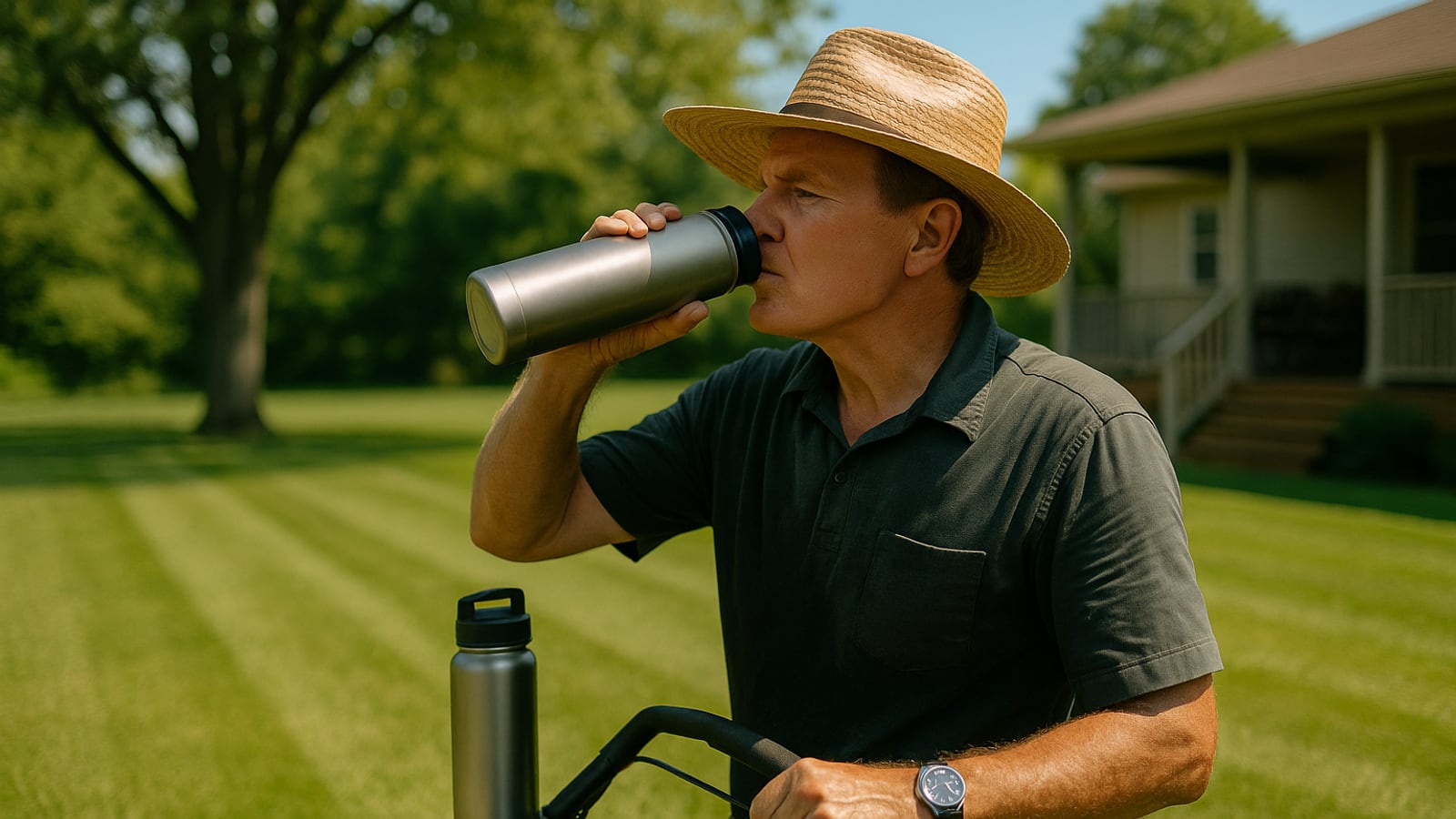
You can be down a full quart and not want a drink. That's the part nobody explains. The thirst signal that ran your whole life like a fuel light quietly stops coming on somewhere after sixty, and it doesn't announce the change. You just notice one August afternoon that you mowed the half acre, came inside, sat down in the recliner and felt like somebody let the air out of you. You weren't thirsty the whole time. You still aren't.
That's the trap. Thirst was never a great gauge, but it was yours, and now it reads low.
The gauge dulls and the tank shrinks at the same time
Two things move against you. The brain's thirst response gets less sensitive with age, so the prompt arrives later and weaker. Meanwhile the tank itself gets smaller, because water lives in muscle, and most men carry less muscle at seventy than they did at forty. Less water on board means the same pint lost matters more.
Then the kidneys get in on it. They hold less tightly to water as the years go on, so you keep making urine when a younger man would start conserving. Three systems, all drifting the same direction, all at once.
Before the practical part, one honest caution. If you're living with heart failure, kidney disease, or cirrhosis, you may be on a deliberate fluid restriction, and more water isn't better for you. Some common medications, including thiazide diuretics and certain antidepressants, can make heavy plain-water drinking dangerous by dropping your sodium. That's a real condition and it lands men in the ER looking confused and unsteady. So the target here's steady, not heroic, and your doctor's number beats mine every time.
The reason you cut back on purpose
Let's say the quiet part. A lot of men aren't dehydrated because they forgot. They're dehydrated on purpose.
You stopped drinking after four o'clock because you were tired of getting up twice a night. You skipped the water bottle on the drive to your daughter's place because you didn't want to hunt for a rest stop on a stretch of highway with nothing on it. You nursed one small coffee through a three-hour grandson's baseball game because the bathroom was a long walk and the bleacher steps had no rail.
Every one of those is a reasonable decision made by a competent adult. They also add up to a man running dry by dinner.
The fix isn't to accept a wet floor and a bad night. It's to move the water earlier in the day and solve the nighttime problem separately. Drink most of your fluid between waking and about six in the evening. Taper after that. Put a nightlight in the hall, clear the path from bed to bathroom of anything you could trip on, and keep a small glass at the bedside for a mouthful, not a refill. If the nighttime trips are frequent and new, that's a prostate and bladder conversation with your doctor, not a reason to stay thirsty for the rest of your life.
What it looks like when it isn't "just getting older"
Mild dehydration in an older man rarely announces itself as thirst. It shows up as other things, and every one of them gets blamed on age.
- A head rush when you stand up. Low fluid volume means low blood pressure on the way up out of the chair. That's a fall waiting on a hard floor.
- The three o'clock fog. Attention and short-term recall dip when you're low on water. Men get talked into worrying about their memory when they were just short a couple of pints.
- Constipation that showed up out of nowhere.
- Headache, dry mouth, a tongue that feels like carpet.
- Dark, strong-smelling urine, and less of it.
- Cramping in the calves at night.
Sudden confusion in an older adult is a different matter and deserves a same-day call, not a glass of water and a wait. Dehydration is one of the common causes. So is infection. Neither one sorts itself out in the recliner.
Two numbers you can actually check
The general guidance figure from the National Academies is about 3.7 liters of total water a day for men, roughly 125 ounces, and that includes what's in your food. Call it eight to ten glasses of actual drinking on an ordinary day, more when it's hot or you're working.
But averages are for populations. You want feedback, and you've got two free sources.
The scale. Weigh yourself first thing, same time, same scale, before breakfast. Day-to-day swings of a pound or two are water, not fat. Drop three pounds between Tuesday and Wednesday after a day in the yard and you didn't lose fat, you lost fluid. Put it back.
The color. Pale, like weak lemonade, means you're fine. Deep amber means catch up. Fair warning, this test lies to you sometimes. A B-complex vitamin turns it fluorescent yellow no matter how well you're doing, beets tint it pink, and some bladder medications turn it bright orange. Know your own baseline.
Drink on a clock, because the feeling isn't coming
Attach fluid to things you already do. Sixteen ounces with the coffee in the morning. A glass before lunch. A glass at two, when you'd otherwise reach for something to wake you up. A glass with dinner. That's most of the way there without a single reminder on your phone.
For hot work, get in front of it. A pint before you start the mower or load the trailer, then about a cup every fifteen to twenty minutes while you're out in it, whether or not you want it. Set the bottle where you'll walk past it, not in the garage fridge where you won't. A man in his seventies sweats less efficiently and sheds heat slower than he did at thirty, and the first sign he's in trouble is often that he's stopped making good decisions about whether he's in trouble.
Water isn't the only thing that counts
Coffee and tea count. The mild diuretic effect doesn't cancel the fluid, and if two cups of coffee is what you'll actually drink, drink it. Alcohol genuinely works against you, which is why a hot afternoon, two beers, and no water is the combination that ruins an evening.
Food carries real water. Soup, broth, oranges, melon, grapes, yogurt, a tomato off the vine. That matters more than it sounds, because appetite also fades with age, and a man eating two small meals a day is quietly getting less water than he used to without touching his drinking habits.
Sweat takes salt with it. If you've been out in the heat for hours, plain water alone can leave you flat. Salted food, broth, or an electrolyte packet does more than another bottle of water. Check with your doctor first if you're on a sodium restriction or blood pressure medication.
The days that actually put men in the hospital
Not August. Stomach flu.
Vomiting, diarrhea, or a fever for two days will empty an older man faster than a week of forgetting his water bottle, and that's the scenario that ends in an IV. Have the plan before you need it. Keep oral rehydration packets or a couple of bottles of electrolyte drink in the pantry. Sip small and often when you can't hold much down. If you can't keep fluids down for a day, or you stop urinating, call. Don't tough it out on the couch to prove a point.
Take the bag to the pharmacist
Diuretics, laxatives, some blood pressure drugs and several bladder medications all change your fluid math. Most men never have that conversation because nobody schedules it.
So schedule it. Put every bottle you take, prescription and over the counter, into a grocery bag and hand it across the counter at your pharmacy. Ask one question: which of these pull water out of me, and what should I be drinking around them? It's free, it takes ten minutes, and the pharmacist will be glad somebody asked.
Your thirst quit its job a while back. It isn't getting rehired. Run the schedule and let it stay unemployed.
This is general information to help you think things through, not medical, legal or financial advice. Please check with your doctor, pharmacist or a qualified adviser before making a change.
Marcus Vale
Editor-in-Chief
Twenty years in magazines, most of it deciding what to cut. Writes about work, discipline and the decisions that compound.

Watch
Worth an hour of your evening
More from BRO Seniors.
From channels we rate. Plays on YouTube.
Read next