
Raise a burr, and the rest of sharpening follows
One skill, one piece of feedback, and about fifteen minutes to learn it. After that your chisels, kitchen knives and axe all get easier.
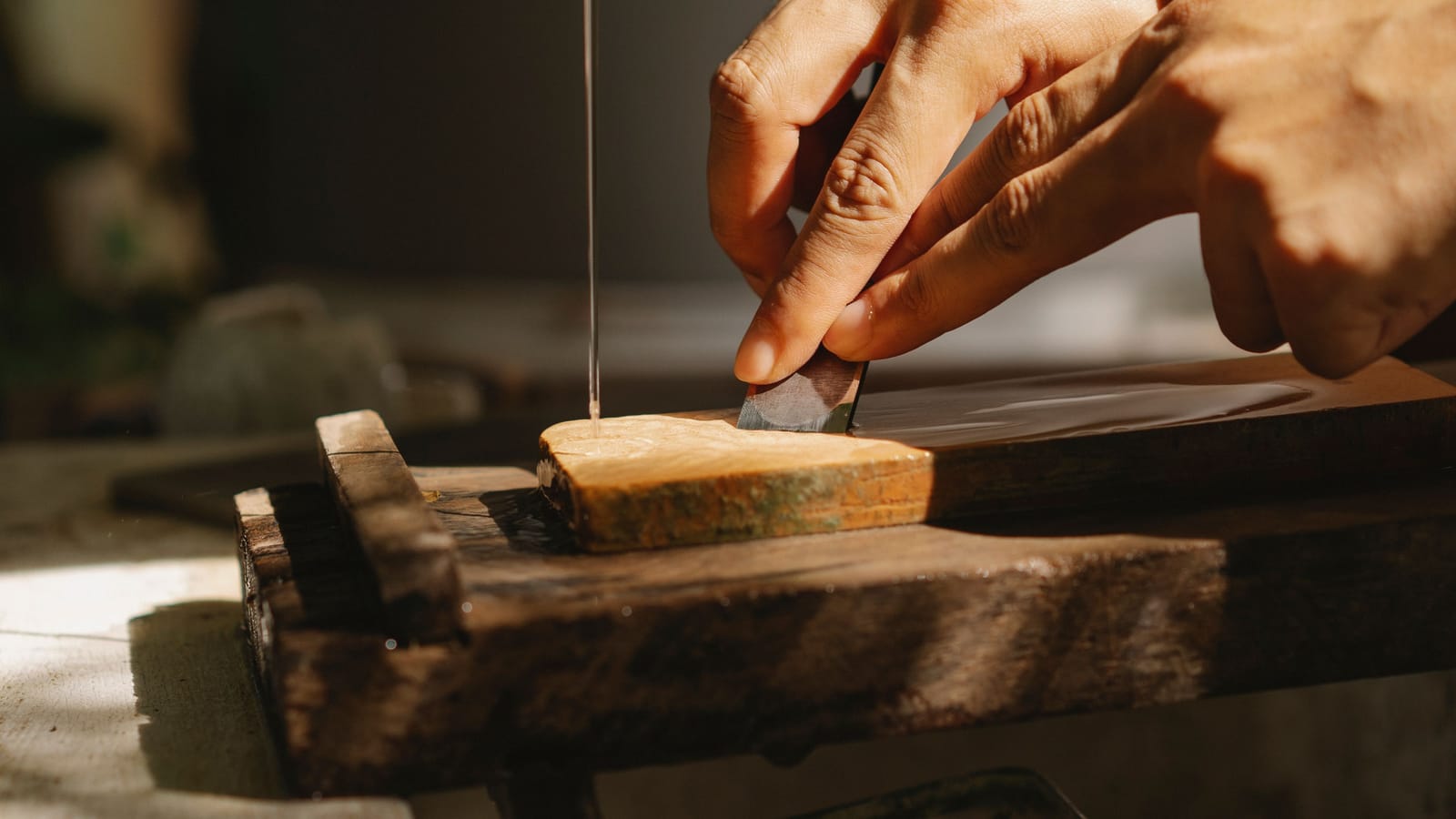
Every tool in your shop that cuts is doing the same thing: forcing two flat surfaces together until they meet at a line so thin it has no width. That line is the apex. Sharpening is nothing more than grinding metal off both sides until the apex is clean, unbent and free of damage.
That's it. Chisel, kitchen knife, plane iron, hatchet, lawn mower blade. Same job, different angles.
Most people never learn it because they never get the one piece of feedback that tells them the truth. So start there.
The burr tells you when you're done
When you grind one side of an edge, metal doesn't vanish. Some of it folds over the apex and hangs off the far side as a thin wire. That's the burr, and it's the only proof you've actually reached the apex rather than polishing somewhere near it.
You feel for it with your thumb, dragged off the edge, never along it. A raised burr feels like a tiny catching lip, similar to the ridge on a badly cut fingernail. If you can't feel it anywhere along the blade, you haven't finished that side. Keep going.
Nearly every failed sharpening job is the same story. Someone polished the bevel beautifully, admired the shine, and never once touched the last few thousandths where the two bevels actually meet. Shiny bevel, dull knife. The burr is what stops that happening.
So the whole process is: raise a burr along the full length of one side, flip, raise it along the full length of the other, then remove the burr with progressively lighter strokes and finer abrasive.
Pick an angle and hold it
Angles are less mysterious than they look, and the tool tells you most of what you need.
- Kitchen knives: roughly 15 to 20 degrees per side. Lower cuts better and chips sooner. Softer European steel is happier nearer 20.
- Chisels and plane irons: a primary bevel around 25 degrees, often with a small secondary bevel a few degrees steeper for the actual cutting edge.
- Axes and hatchets: much steeper and slightly rounded, because they hit knots and frozen wood and a thin edge will fold.
- Pocket knives: around 20 per side is a sensible default for a tool that opens boxes and cuts rope.
Twenty degrees is about the angle of two stacked matchbooks under the spine of a kitchen knife. That's a good enough starting reference for your hands to learn the feel.
Two rules matter more than the exact number. First, consistency beats precision. A steady 22 degrees sharpens far better than a wobbling 15 to 25. Second, matching the existing bevel is almost always faster than imposing a new one, because re-grinding a whole bevel takes real time.
To find the existing angle, color the bevel with a marker and take two light strokes. Where the ink comes off is where you're touching. Ink gone at the edge, still there at the shoulder means you're too steep. Gone at the shoulder, still at the edge means too shallow. Adjust and check again. That trick alone fixes most beginners.
What to buy, and what to skip
You need less than the internet suggests. A double-sided diamond plate, coarse on one face and fine on the other, will sharpen nearly everything you own and never needs flattening. Add a leather strop with a bar of polishing compound and you've covered the last step.
Waterstones cut faster and leave a better edge, but they dish out of flat and need a flattening plate and a bucket of water. Worth it if you're sharpening chisels regularly. Overkill if you sharpen the kitchen knives once a season.
A mill file and a round file handle axes, mower blades and shovels. Nothing finer is required for tools that live in dirt.
Skip pull-through sharpeners with carbide V-notches. They don't sharpen, they tear steel out of the edge, and they leave a knife that feels sharp for a week and then needs real repair. Powered wheels are for people who've already learned the hand skill, because a grinder will overheat and ruin a thin edge in about two seconds.
The actual sequence
Set the stone on a damp cloth so it can't slide. Mark the bevel. Find the angle.
Work the first side with moderate pressure, using the full surface of the stone rather than the middle third. Stroke direction doesn't matter much, but consistent pressure does, and so does covering the whole blade from heel to tip. Curved blades need the handle to lift slightly as you reach the belly and the tip, or the tip stays dull. Almost everybody's first sharp knife has a dull last inch.
Check for a burr every dozen strokes or so. When you can feel it along the entire length, stop and flip.
Do the same on the other side. The burr will flip over to the first side. That's the signal you've reached the apex from both directions.
Now go to the fine side of the plate and use much lighter strokes, alternating sides. You're not removing steel any more, you're removing the burr and tidying the apex. Finish on the strop, dragging the blade spine-first so you don't slice the leather. Ten passes a side is plenty.
Chisels and plane irons deserve one extra step
The back of a chisel is half the edge, and a factory back is rarely flat. Before you touch the bevel on a new chisel, lay the back flat on the coarse stone and work it until the first inch or so is uniformly scratched with no low shiny patches near the edge.
This is a one-time job per tool and it's tedious. Do it anyway. A chisel with a hollow behind the edge can never be sharp, no matter how good the bevel is, and you'll waste years wondering why.
After that, the back only ever gets laid flat for a few burr-removing strokes. Never a raised angle on the back. Not once.
Signs you got it wrong
It cuts paper but not tomatoes. The burr is still attached and acting like a saw. Strop it off.
Sharp in the middle, dull at the tip. You didn't lift for the curve.
Sharp on Monday, dull on Wednesday. Either too thin an angle for the work, or you overheated the steel on a powered wheel and lost the temper.
Nothing's happening at all. You're too shallow and only touching the shoulder, or the abrasive is too fine for the amount of metal you need to move. Go coarser and stop being polite about it.
Test it honestly
Cut paper, held loose in one hand, starting at the heel. A properly sharp edge bites immediately without sliding. Then do the thing that actually matters: use it. Slice an onion. Pare end grain. A chisel should shave a curl off the corner of a board with hand pressure alone and leave a burnished face, not a torn one.
Then keep it there. A few strops before each session will hold an edge for weeks and takes twenty seconds. Full sharpening is what you do when maintenance has lapsed, and if you're doing it often, you're not stropping enough.
Sharpen the kitchen knives first. You'll get the reps faster than in the shop, your wife will notice inside a day, and the first time your son asks you to do his pocket knife you'll have something to teach him that he'll still be using at fifty.
Wes Dunbar
Country & Skills
Grew up on an acreage and never quite left. Covers trucks, trades, land, and how to do the thing yourself.

Watch
Worth an hour of your evening
More from Woodworking.
From channels we rate. Plays on YouTube.
Read next